 LeCoqRoti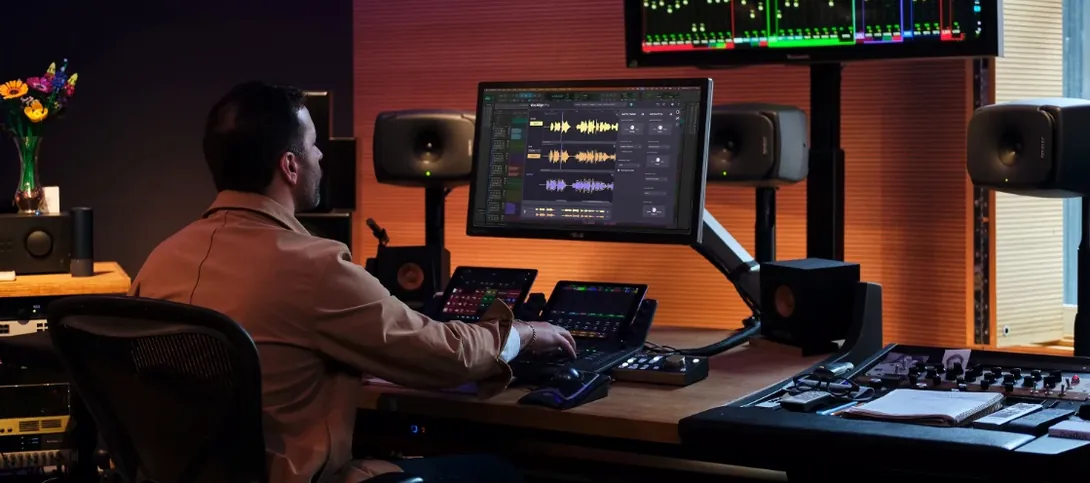
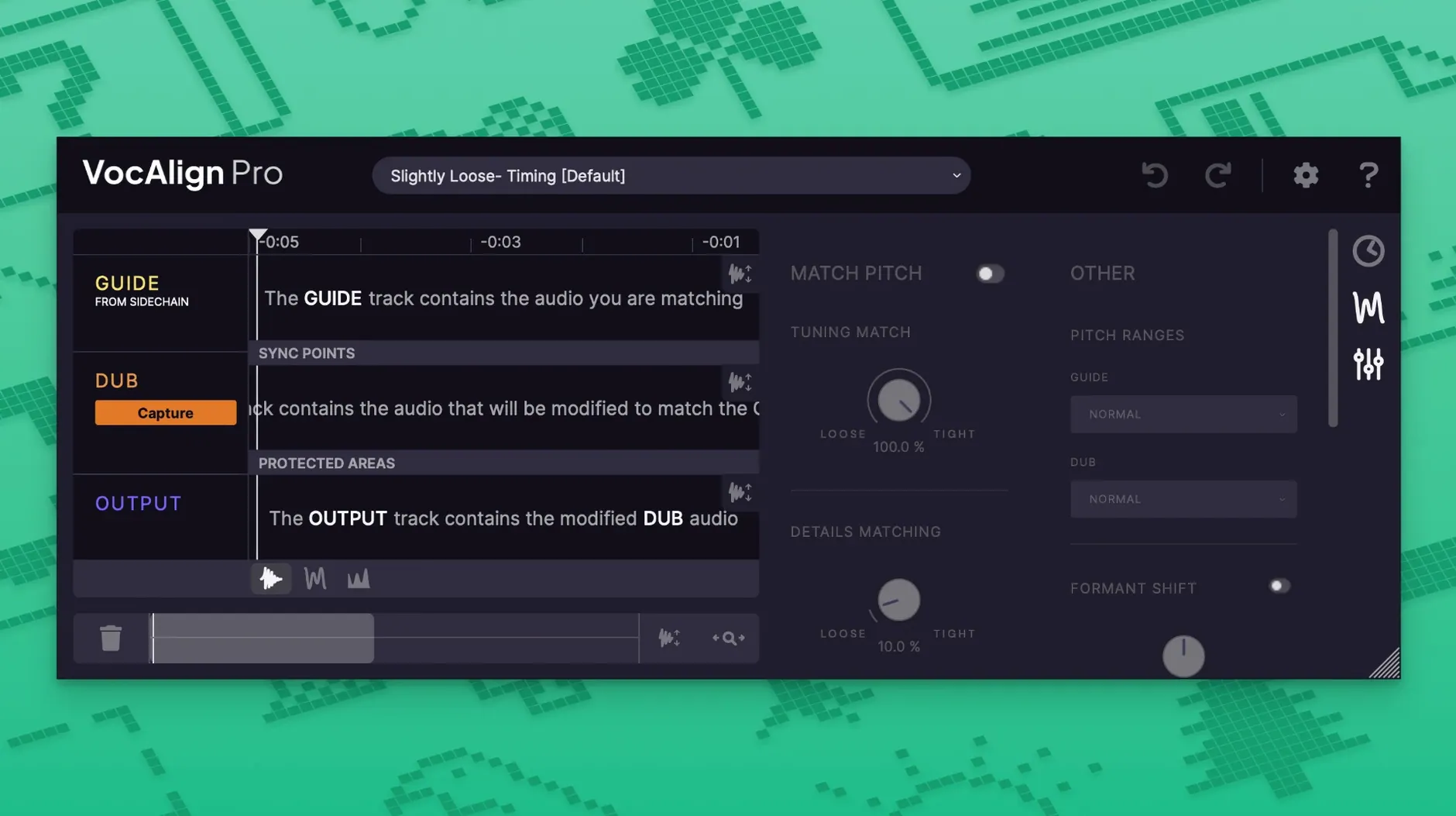
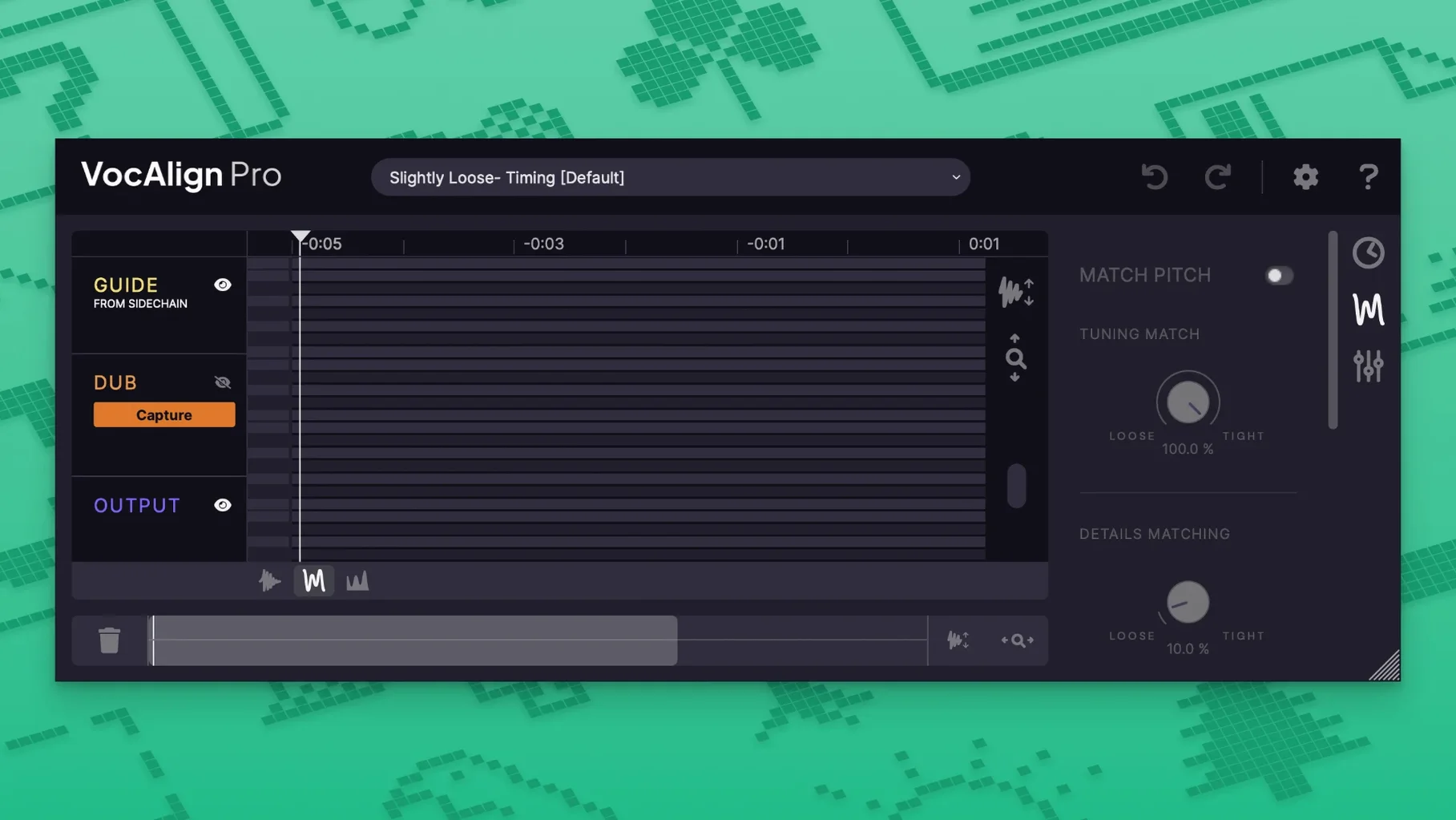
The interface has been rethought to make alignment feel less like a technical chore and more like a deliberate mix decision: a larger waveform view and clearly separated time and pitch controls let you see exactly what you are adjusting.
SmartAlign — an automatic detection system that decides which sections of a performance need tightening and which should breathe. It reduces the need to manually define alignment regions.
SynchroLink with RePitch — a direct connection that lets pitch edits in RePitch feed into VocAlign, so the timing already set in one place does not need to be rebuilt in another.
Arm Capture All — captures every relevant track with one click, useful when a session holds multiple guide and dub tracks and you want to align them in a single pass.
Transpose shift — pure pitch displacement, independent of the time alignment engine. The sound moves in semitone steps, cleanly, without touching the groove underneath.
In short: the controls are named for what they actually do to a signal, and the interface stays out of the way once you set it.
Common snags: when alignment drifts or warbles
A few problems surface often enough to be worth addressing before they slow a session. The first is alignment that sounds tight in the centre but loose at the edges. This usually means the guide and dub signals differ too much in level or background noise. VocAlign reads both signals as a whole, so a noisy guide track confuses the detection. The fix is simple: strip silence or gate the guide lightly before capture, especially on dialogue recorded in untreated rooms.
Another classic: the aligned dub suddenly warbles or sounds phasey. That points to the Tightness control being set too high for the material. VocAlign tries to follow every micro-fluctuation, and on a breathy vocal or a bass with long decay, that creates artefacts. Back off Tightness in small increments until the warble disappears; you rarely need the maximum setting for a natural result.
When the plugin appears to do nothing at all after capture, the culprit is almost always a misrouted side-chain or a track that was not armed before Arm Capture All was pressed. VocAlign expects the guide on one input and the dub on the other; double-check the routing matrix in your DAW, then recapture. On Pro Tools systems with ARA, a session that has been opened across different machines sometimes loses the ARA link — closing and reopening the plugin re-establishes it without losing the alignment data already stored in the clip.
Finally, pitch alignment that sounds robotic on long sustained notes can be tamed by switching SmartPitch to a narrower correction range. The full-range mode works well on short phrases but can over-correct a held vowel. Narrowing the range tells VocAlign to ignore pitch drift that falls outside normal expressive variation.
Alongside other alignment tools: three comparisons
Placed next to Celemony Melodyne, VocAlign 6 Pro feels purpose-built rather than general-purpose. Melodyne edits pitch and timing note by note with extraordinary surgical control, and it remains the choice for tuning a single vocal to perfection. VocAlign does not attempt that depth of manual editing; it matches one performance to another in a single gesture. The trade-off is time: aligning a double-tracked chorus in VocAlign takes seconds, where Melodyne asks for note-by-note attention. Producers who already own Melodyne often keep both — one for detailed tuning, the other for rapid alignment across stacks of backing vocals.
Revoice Pro, from the same developer, shares the alignment engine but adds independent time and pitch manipulation, a warping interface, and the ability to generate doubled parts from a single take. VocAlign 6 Pro strips that back: it aligns existing audio, fast, inside your DAW. Revoice Pro suits sound designers and dialogue editors who need to manually bend a waveform; VocAlign suits mix engineers who want the alignment done before the coffee cools. The ARA integration in VocAlign 6 Pro also edges slightly ahead in Pro Tools workflows, where Revoice Pro still relies on its standalone application for certain operations.
Compared with Waves Vocal Rider, the difference is categorical. Vocal Rider rides gain; it does not touch timing or pitch. A producer correcting loose doubles would reach for VocAlign first and then perhaps apply Vocal Rider afterwards for level consistency. The two complement rather than compete.
First days: a sensible setup routine
The plugin installs quickly — open the disk image and run the installer — but a few early habits make the first week smoother.
Set up your presets early. VocAlign ships with a handful of alignment presets, but they are starting points. Spend twenty minutes on your first day feeding it the material you work with most — spoken word, sung leads, stacked harmonies, bass DI versus amp — and save a preset for each. Name them after the source type, not the settings, so you recall them by context rather than by numbers.
Learn where SmartAlign gets it right, and where it does not. On tightly performed pop vocals, SmartAlign rarely needs help. On a loose guide track with long pauses, it sometimes leaves gaps unaligned that you wanted tightened. In those cases, place a sync point at the start of each phrase before capture. A few well-placed sync points give the algorithm the anchoring it needs, and the result snaps into place.
Use process groups from day one if you work with multitrack drums. Capture all close mics as a single process group so the time relationship between snare top and snare bottom stays locked. Aligning each mic independently to a guide track creates micro-shifts that smear the phase coherence of the kit. The group behaves as one instrument, which is how it was recorded.
Train your ear, not just your eye. The resizable waveform view is clear and useful, but alignment should be judged by listening. Solo the dub against the guide and toggle bypass several times before you commit. What looks perfectly aligned on screen can still feel stiff, and a small manual Tightness adjustment often restores the groove without losing the timing correction that matters.


Correspondence 0
Take a chair or join the table to send a letter.
No correspondence on this note yet. Letters are read before they appear.