 LeCoqRoti
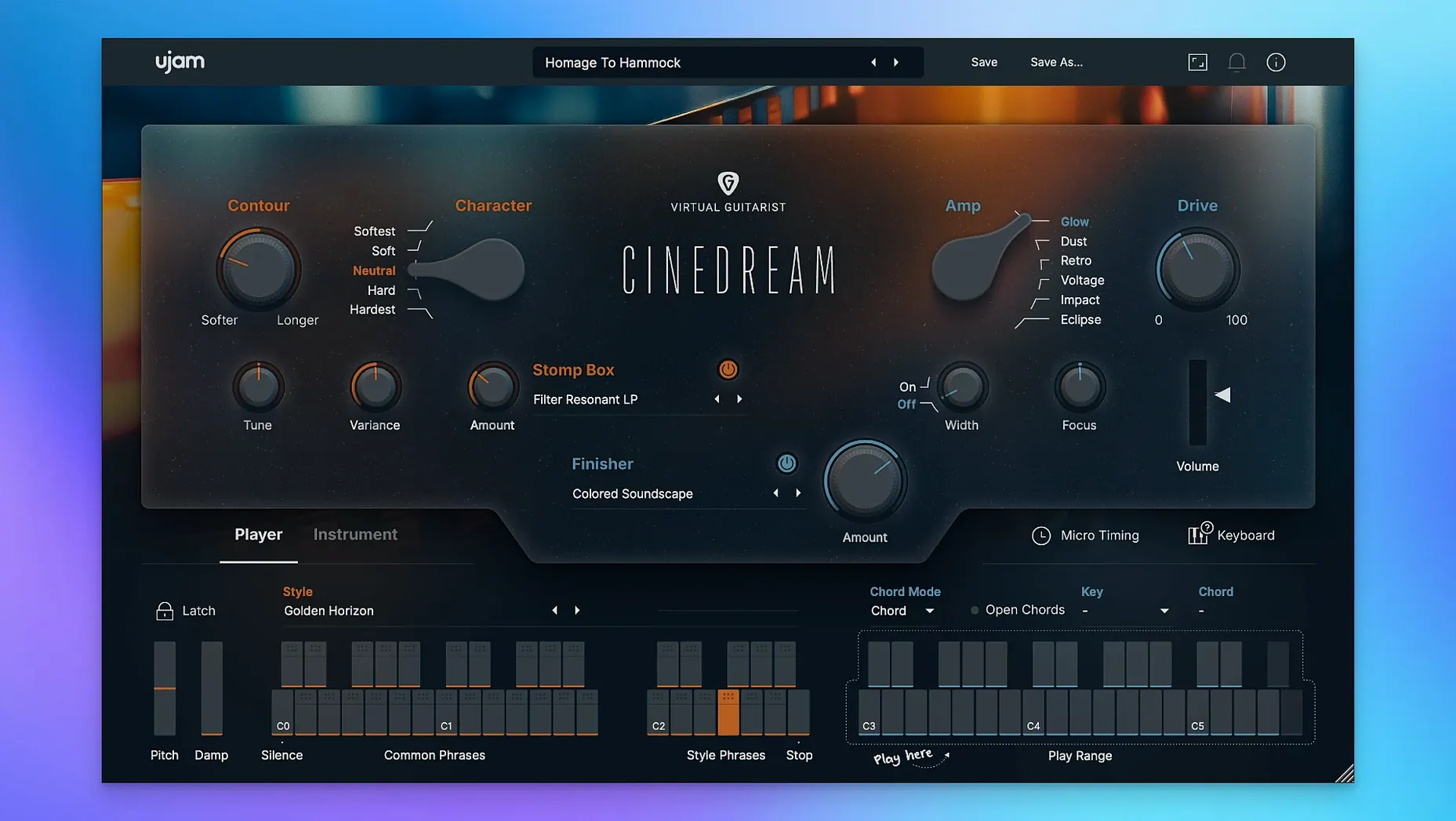
Not every track needs a lead guitar. Some pieces ask for something softer — a wash of tone that moves beneath the surface, filling space without demanding attention. That is the problem Cinedream sets out to solve, and it does so with a single chord trigger that sets layered guitar parts into motion the moment you press a key.
Formats and hosts: where it fits
The instrument loads as VST3, Audio Unit or AAX on Intel and Apple Silicon Macs, with native ARM support alongside Rosetta. It runs under macOS Monterey 12 through to macOS Tahoe 26, and asks for 8 GB of RAM and roughly 4 GB of free disk space. An internet connection is required during setup.
Sound: from clean shimmer to saturated drift
The core palette moves between two poles: a soft, clean tone for airy pads and a rougher, saturated voice when the texture needs weight. Everything sits in the background by design — evolving loops, slow attacks and long decays that suit soundtrack cues, ambient beds and passages built on atmosphere rather than melody.
Interface: one trigger, many layers
A single chord sent from your keyboard or DAW starts an automatic performance of interlocking guitar parts. There is no need to programme picking patterns or voicings; the engine handles that internally, leaving you to shape the result with a few macro controls. The interface is in English only.
Who benefits most: composers, producers and sound designers
Film composers working to picture tend to reach for Cinedream when a scene calls for texture rather than a theme. A slow pan across a landscape, a moment of quiet before dialogue, a transition that needs breath — these are the cues where an evolving guitar wash does more than a static string pad. The instrument responds to a single chord and then gets out of the way, which matters when you are spotting against picture and do not want to programme a performance note by note.
Ambient producers will find the same economy useful, though for different reasons. Building a track around slow harmonic movement often means layering several sources that drift in and out of phase. Cinedream supplies one of those layers with little effort: hold a chord, let it evolve, and dedicate your attention to the elements that need detailed shaping. The clean-to-saturated control makes it simple to push a layer forward or tuck it back without opening an EQ.
Sound designers working on game audio or installation pieces can treat the output as raw material. Recording a long chord into the DAW and then slicing, pitching or reversing the result yields fragments that still carry the organic attack and finger noise of a real instrument, even after heavy processing. That combination of human source and electronic treatment sits well in hybrid sound design where purely synthetic textures feel too cold.
Songwriters and beat-makers who occasionally need a cinematic bridge or intro may use the instrument less often, but when they do, the ready-made styles spare them from dialling in a chain of reverb, delay and modulation from scratch. One or two chords placed in a break can lift a production without pulling focus from the vocal.
DAW integration: MIDI in, audio out in any AU/VST3/AAX host
Cinedream works inside any DAW that hosts AU, VST3 or AAX plug-ins — Logic Pro, Ableton Live, Cubase, Pro Tools and Reaper are all natural homes. Once loaded, it behaves like any software instrument: MIDI in, audio out. Routing the output to a bus with additional convolution reverb opens up spaces well beyond the built-in effects, and placing a tape emulation or a gentle compressor after the plug-in can glue the texture into a mix that already contains acoustic instruments.
Because the instrument generates stereo audio from a monophonic chord input, it pairs neatly with spatial tools. Sending Cinedream into a utility that separates mid and side information lets you widen the texture further or keep it narrow and centred behind dialogue. Users who work in Dolby Atmos may place the stereo output into a bed or use an object panner to move the wash around the room slowly — a technique that suits long ambient cues.
On the macOS side, the plug-in integrates with the system’s audio routing without extra configuration. Aggregate devices, multi-output setups and Core Audio’s sample-rate switching all function as expected. The installation places components in the standard Library folders, so any DAW that scans those locations will find the instrument on launch. There is no separate standalone application; it runs only as a plug-in.
Within the UJAM ecosystem, Cinedream shares a design language with the other Virtual Guitarist instruments, but it occupies a distinct corner. Where Silk or Amber deliver rhythmic strumming, Cinedream deals in sustained atmosphere. Loading both in a session — Cinedream on a pad track, Amber on a picked verse — gives you two complementary guitar flavours that share the same macro-control philosophy.
Guitar requirement: no instrument needed, just MIDI notes
Does it need a guitar connected, or can I play it from a keyboard? No guitar is required. The instrument receives MIDI from any controller or piano roll. The chord you trigger can be a simple triad or a more complex voicing — the engine interprets the notes and generates an appropriate performance from its internal library of processed guitar recordings.
Will it work on an older Mac that cannot run the latest macOS? The plug-in supports macOS 10.13 and later, so machines that cannot move beyond High Sierra, Mojave or Catalina remain compatible. Apple Silicon Macs are supported natively, and Intel machines with 64-bit processors run the plug-in without translation layers. The minimum display resolution of 1280 by 768 pixels is modest enough for older MacBook Airs and 13-inch MacBook Pros.
How much control do I have over the performance, or is it all automated? The instrument is designed around automation, but not at the expense of shaping. You decide the chord, the duration, the style preset, the tonal character and the effect mix. What you do not control are the individual note choices and picking patterns — those are generated by the engine. The trade-off is deliberate: speed for detailed programming, in exchange for results that sound like a guitarist playing, not a piano roll grid.
Does it produce only clean sounds, or can it get heavier? The range goes from a near-transparent clean tone through to a saturated, slightly overdriven voice. It will not replace a high-gain amp sim, nor is it meant to. The saturation adds body and a little edge, useful when the texture needs to sit against percussion or hold its own in a denser arrangement.
A start-to-finish workflow: scoring a 45-second drone cue
Imagine a short film sequence — an aerial shot moving slowly over water at dawn. The director wants a cue that feels suspended, with motion beneath the surface but no obvious melody. Here is one way to build it with Cinedream at the centre.
Begin in Logic Pro with a new project at 48 kHz, 24-bit. Create a software instrument track and load Cinedream as an Audio Unit. Browse the style presets using the arrows on the interface until you find a slow attack setting with pronounced modulation — something that breathes. Set the tonal character roughly one-third of the way from clean toward saturated, so the texture has a faint edge without becoming gritty.
Open the piano roll and draw a single chord across eight bars: D minor, voiced with a low D, the F above it and the A above that. Let the chord sustain for the full duration. The engine begins generating guitar layers immediately; the longer the chord holds, the more the internal variations unfold. Hit play and listen without any additional processing. You should hear movement — slight shifts in timbre, a slow rise and fall in intensity, the sense that something is alive inside the pad.
Now route the Cinedream track to a bus with a convolution reverb set to a large hall impulse response. Dial the wet mix to around 40 percent. Add an instance of a tape delay on a second bus, set to dotted eighth notes with high feedback and low mix, and send a small amount from the guitar track. The delay adds a rhythmic ghost that suggests a pulse without stating it explicitly.
Create a second software instrument track with a simple sine-wave sub-bass. Programme a single low D that follows the chord length, and set its level so you feel it more than hear it. The combination of the airy guitar wash, the hall reverb, the faint delay and the sub-bass weight gives the cue a sense of depth and forward motion — all from one held chord and a handful of mixing decisions.
In short: the instrument handles the performance; the producer handles the space around it.




Correspondence 0
Take a chair or join the table to send a letter.
No correspondence on this note yet. Letters are read before they appear.