 LeCoqRoti
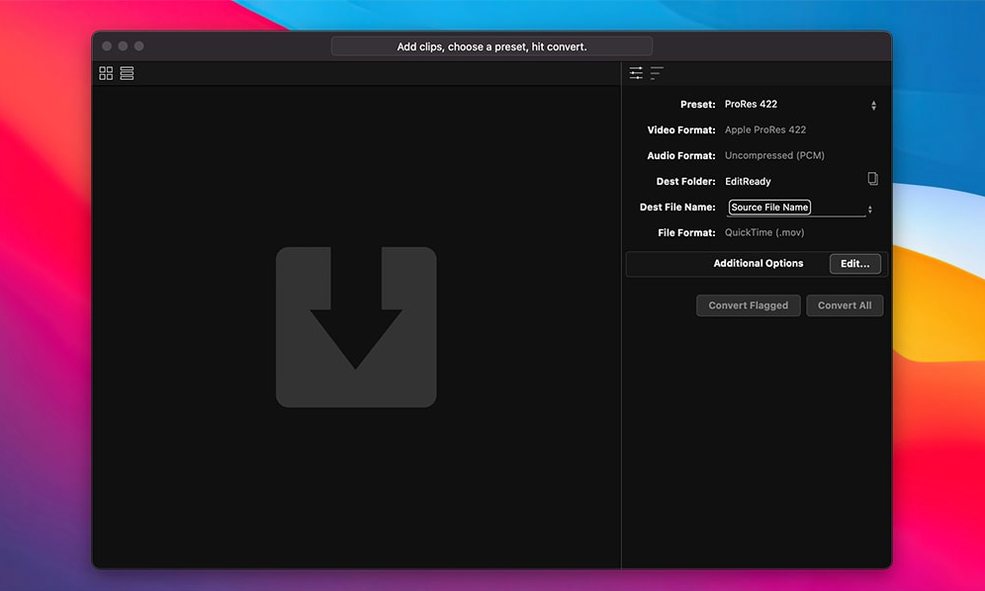
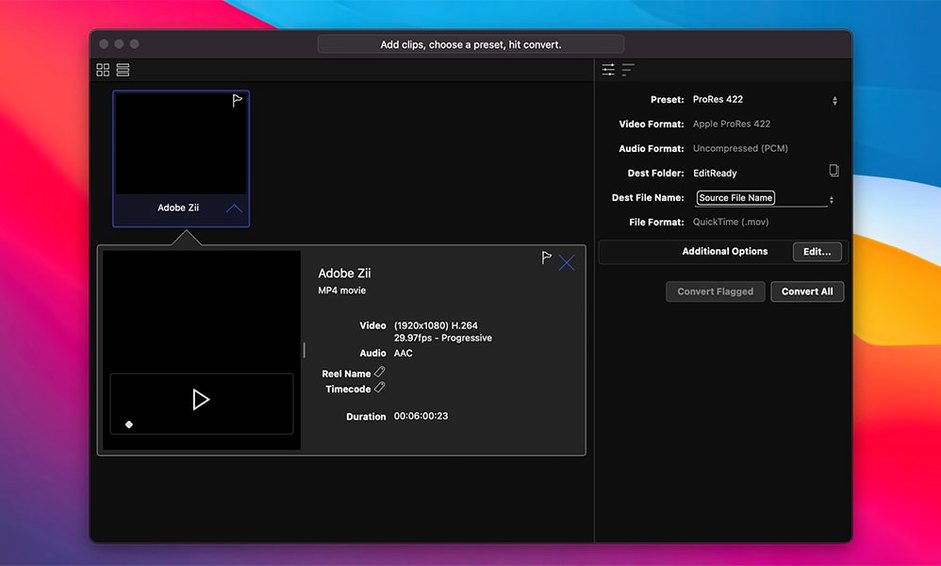
EditReady is used by editors and DITs who need to prepare footage before it ever reaches the timeline. It rewraps and transcodes, certainly, but the reason it stays in a professional toolkit is the attention it pays to what surrounds the image: timecode, camera metadata, spanned clips.
Metadata: preserved, viewed, edited
Most conversion tools discard ancillary data as a matter of course. EditReady keeps it intact through the transcode, and when a project demands a change — correcting a timecode offset, adding reel names — the same interface lets you view and edit those fields directly. It is a small thing that saves a call to the DIT.
Span detection: one clip from many files
Long takes split across file chunks are a fact of life with GoPro, AVCHD, M2T and multi-file MXF. The app detects these spans automatically and combines them into a single, continuous clip on output. No manual stitching, no guessing which segment belongs where: just one clean master file ready for Final Cut Pro, Premiere Pro or Avid Media Composer. GPU acceleration keeps the process brisk.
Spanned clips unified: a card-to-proxy walkthrough
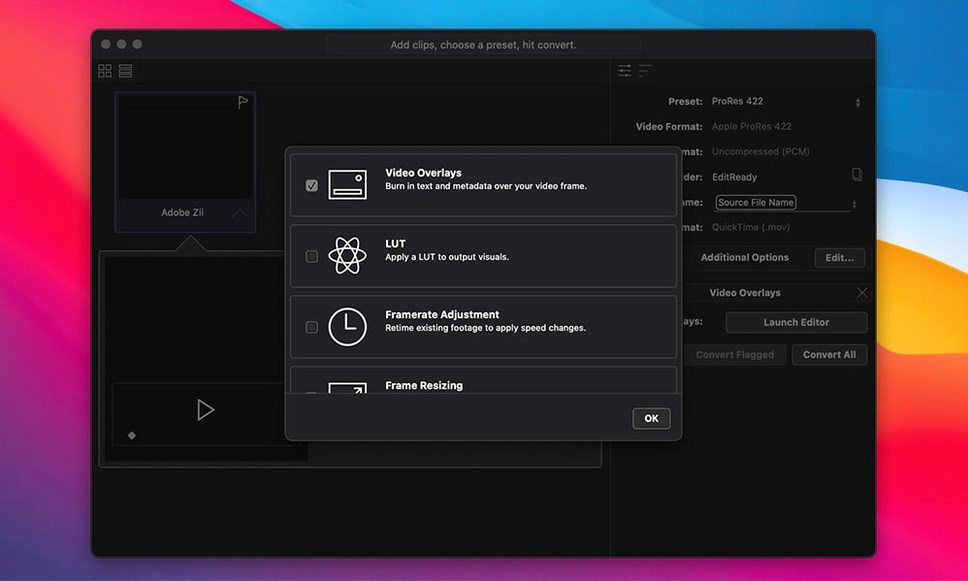
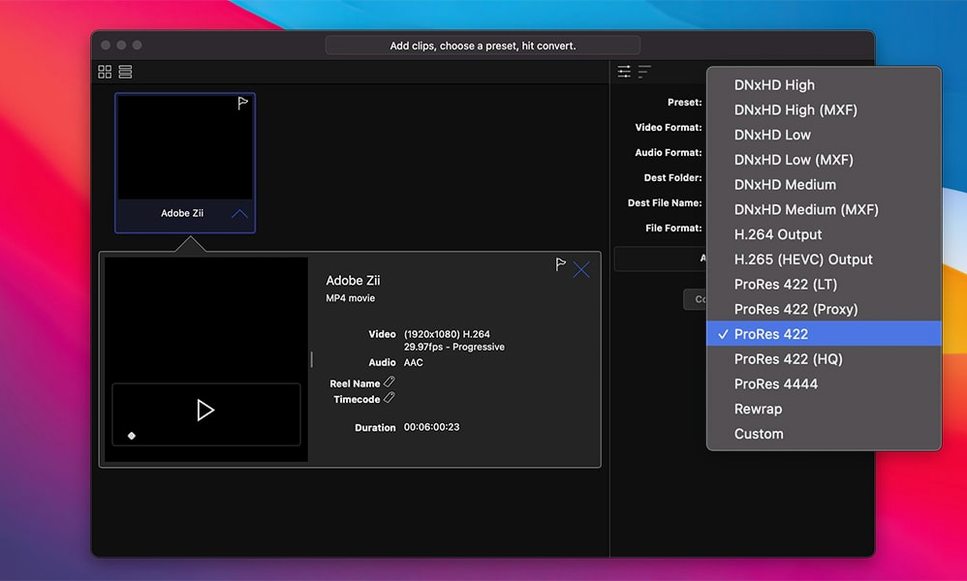
A card arrives from set. You mount it, open EditReady, and the browser fills with thumbnails — some single MXF files, one a three-chunk AVCHD span that immediately shows as a single entry. You select everything. In the inspector on the right, you skim the first clip: camera metadata is all present, but the reel name field is blank. You type a short code and tick the box to apply it across the selection. One LUT is dragged onto the batch — a technical transform from S-Log3 to Rec.709, just for dailies. Output is set to ProRes LT, with a destination folder on the working drive. You press Convert and walk away. When you return, the dailies are ready and the original card structure is untouched on the desk beside you.
A scenario: assistant editor on a documentary
Imagine an assistant editor receiving a drive with two years of archival material. The formats are a museum: MTS from an old handycam, H.264 interviews, a folder of Blackmagic RAW shots. The NLE is Avid Media Composer. They point EditReady at the whole drive, group transcodes by codec, apply a DNxHD 36 preset for offline editing, and let the batch run overnight. Spanned MTS clips are stitched automatically; the Blackmagic RAW files get a gentle LUT to bring them into a viewable colour space. By morning, everything is in a single Avid MediaFiles folder with consistent timecode and reel names. The assistant opens Media Composer, drags the folder into a bin, and starts syncing without a single conform issue.
Transcoding without a timeline: friction next to Resolve
Set beside DaVinci Resolve, EditReady occupies a narrower role but executes it with far less friction. Resolve can transcode anything, yet it demands a project library, a timeline, and a render queue that expects colour decisions. For pure dailies work, EditReady is the faster, quieter path: no project management, no timeline, just a source and a destination. Where Resolve asks the user to operate a finishing suite, EditReady works more like a dedicated lab machine.
Compared with Apple Compressor, the differences are structural. Compressor integrates tightly with Final Cut Pro and works well for export-focused encoding, but its handling of professional camera formats — especially spanned clips and MXF metadata — is less thorough. EditReady reads camera folder structures directly and preserves metadata that Compressor would simply drop. It also edits that metadata before encode, a capability Compressor does not offer at all.
Shutter Encoder is a capable, free alternative with a broad codec list, but the interface tells a different story. Where Shutter Encoder exposes every parameter in a long scrolling panel, EditReady pares the view down to the controls a post workflow actually needs: codec, resolution, LUT, reel name. The result is fewer mistakes under pressure and a shorter path from card to timeline. In short: if Shutter Encoder is a versatile multi-tool, EditReady is a purpose-built prep station.






Correspondence 0
Take a chair or join the table to send a letter.
No correspondence on this note yet. Letters are read before they appear.