 LeCoqRoti
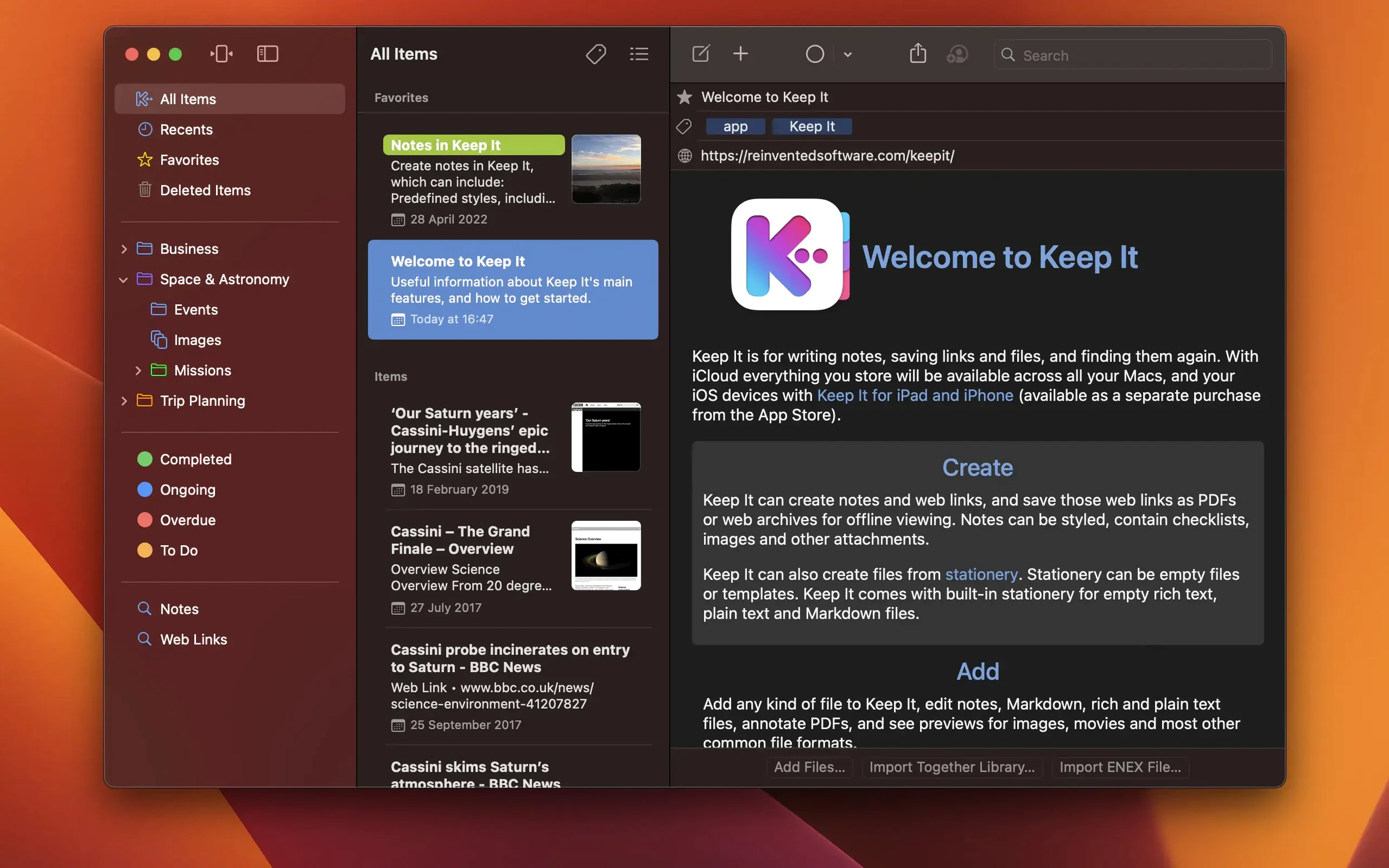
Over a hundred web links, forty PDF manuals, and a folder of handwritten recipe scans: a Mac can collect stray information faster than anyone can sort it. Keep It for Mac is built for exactly that situation — a notebook and document organiser that treats notes, images, web pages and files as equal citizens in one browsable library.
Inside the library: what it holds
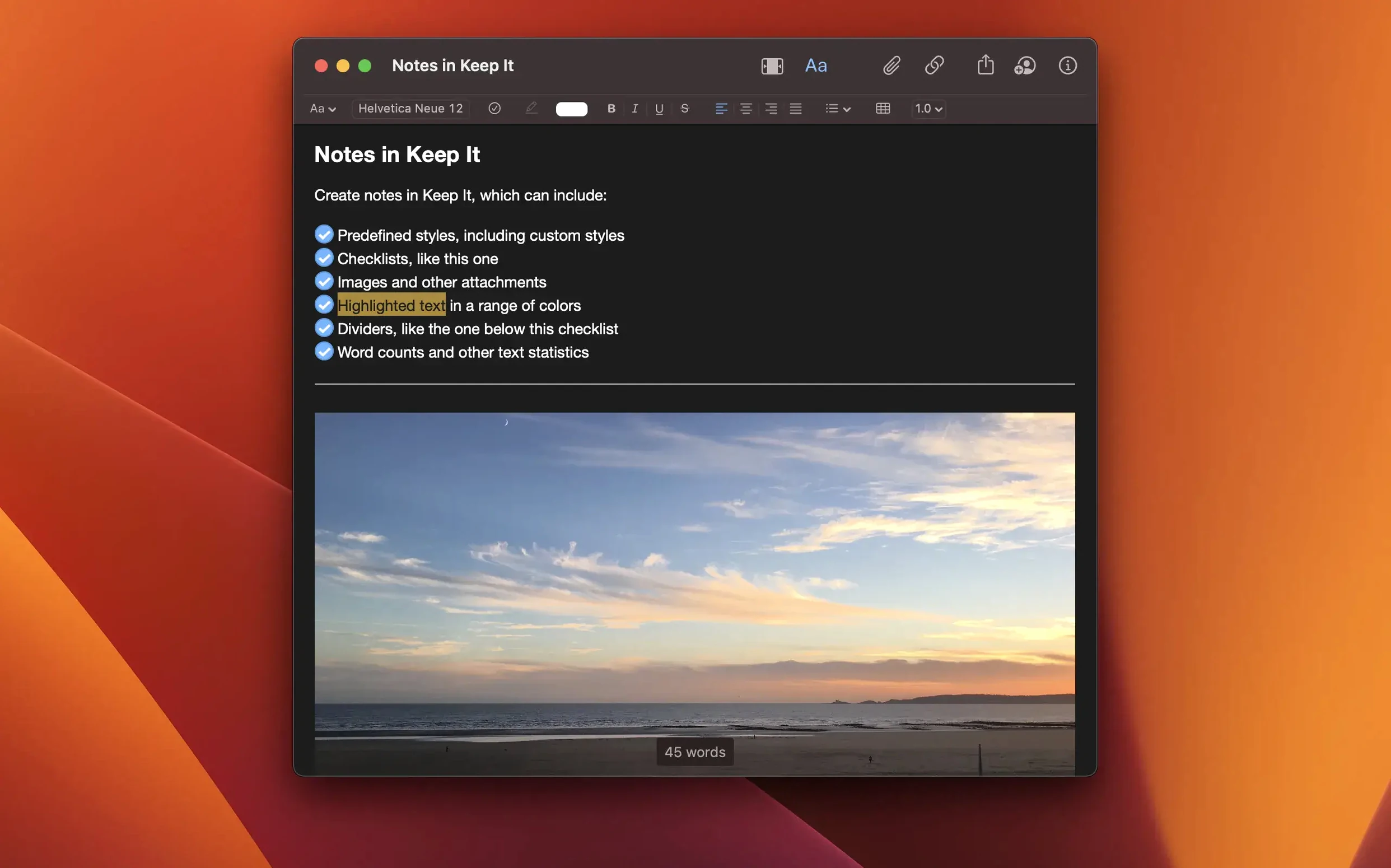
- Notes — formatted text, plain text or Markdown files, editable right inside the app.
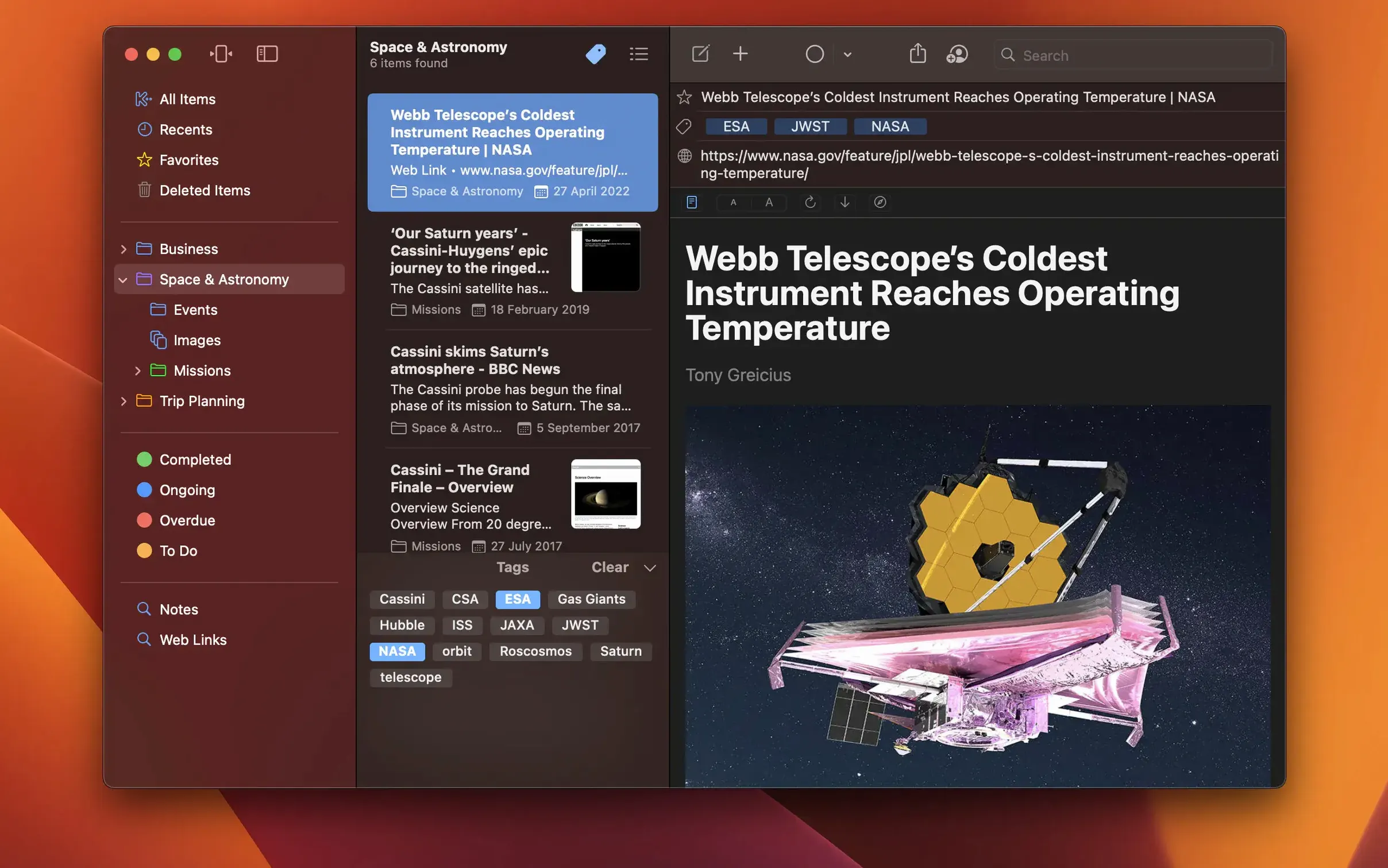
- Web links — saved as bookmarks, viewed in-app, opened in a browser, or converted into editable notes and PDFs.
- Files of any kind — dragged in, saved from other apps via the Share extension, or created from stationery and opened for editing elsewhere.
- Folders and bundles — a hierarchy that mirrors what you see in Finder, because that is exactly what it is.
The Finder advantage: files, not a locked vault
Everything added to Keep It stays as an ordinary file, folder or tag on your disk. Rename a document in Finder and the change appears in the app; drag a new image into a folder while the app is closed, and it is waiting there when you return. Labels add a layer of colour coding, deleted items hang around for a thirty-day grace period, and saved searches let you return to a complex query without rebuilding it. Automation is covered too: AppleScript and Shortcuts can handle repetitive tasks.
Speed and footprint: a quiet companion
What becomes clear after a week of daily use is how little attention Keep It demands of the system. The library, even with several thousand items and a mix of large PDFs, scans and web archives, opens without a progress bar. Search results narrow as you type, and the lag between pressing Return and seeing a filtered list is barely perceptible on both Apple Silicon and Intel machines. Memory usage sits modestly for an app that indexes full-text content and renders previews — typically under 300 MB in active use — and background CPU activity drops to near zero once indexing finishes.
Stability under macOS 15 Sequoia is unremarkable in the best sense. Switching between the three-pane browser and compact mode does not provoke redraws or beachballs, and dragging a mail message from Apple Mail — a gesture that once triggered a crash, now patched in version 2.9.1 — behaves as expected. The one resource quirk worth knowing: importing a folder with hundreds of high-resolution images simultaneously can spike CPU for a minute while thumbnails generate. Spreading large imports across a few smaller batches avoids it entirely.
Broader than Eagle but less image-centric
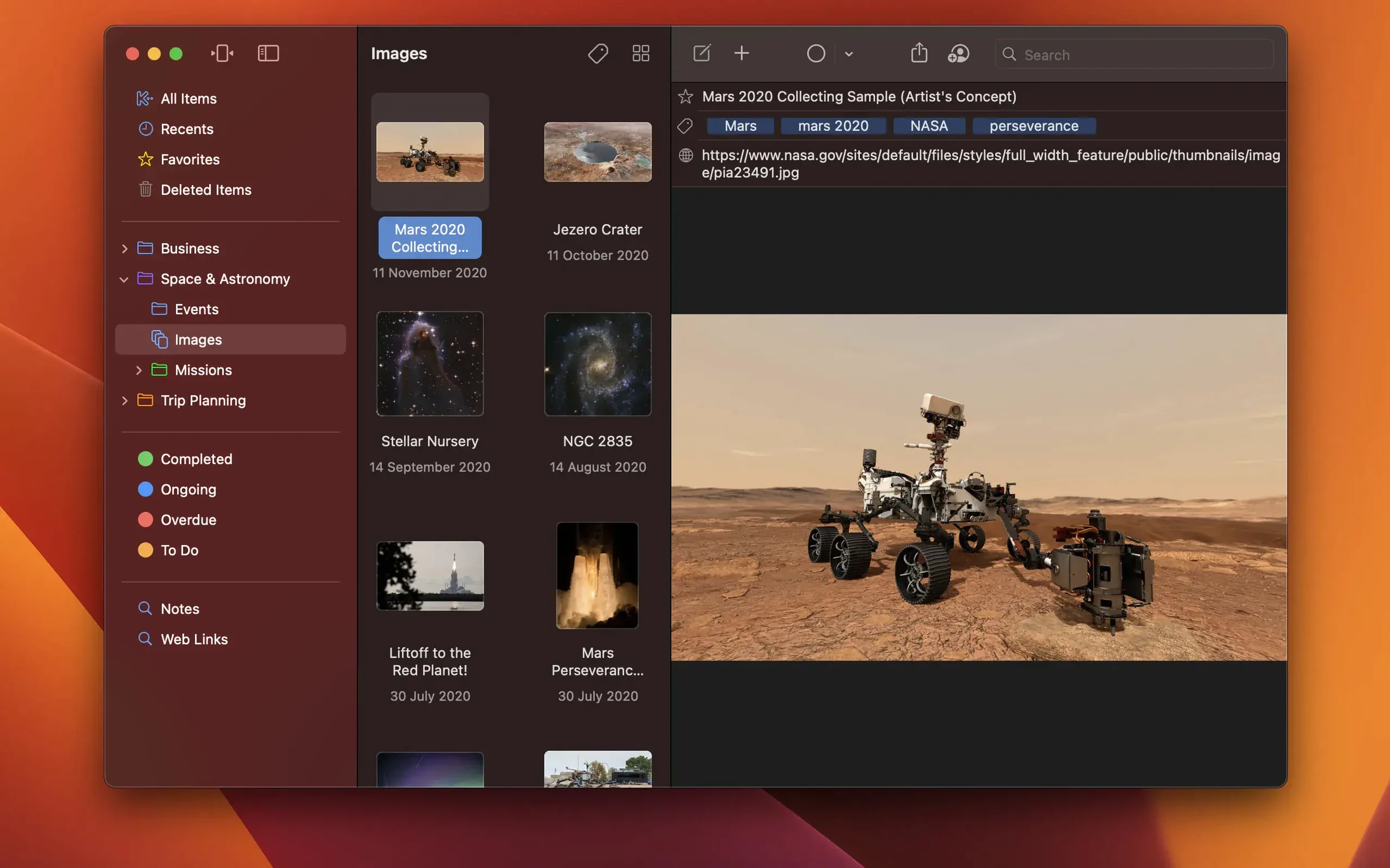
Measured against Eagle, the image and asset manager, Keep It feels broader but less visually driven. Eagle treats every item as a thumbnail-first object with extensive tagging and annotation panels; Keep It handles images but keeps them alongside notes and web links in a text-forward layout. A designer curating a visual reference library may find Eagle’s grid and colour extraction tools more natural. Someone managing project research with PDFs, meeting notes and saved links will find Keep It’s mixed-media approach more practical.
DEVONthink is the heavyweight comparison. Both apps store files in Finder-accessible structures, both offer AI-assisted classification and both value data portability. DEVONthink’s rule-based filing and deep scripting give it an edge for research-intensive workflows, but its interface can feel dense. Keep It trades some analytical power for a cleaner organisational model: folders, bundles, labels and a single search field that scans everything. The choice often comes down to appetite for complexity. For a keep it mac app that welcomes files without burying them in a proprietary database, Keep It makes a strong case.
Apple Notes is the obvious lightweight reference point. It excels at quick capture and sync, but its file-handling is rudimentary — PDFs and images attach to notes rather than existing as independent items with their own metadata. Keep It treats a PDF as a first-class object that can be highlighted, annotated and found alongside everything else.
Disappearing items after a fresh download
A handful of friction points surface in user forums and support threads, most with straightforward remedies. The most frequent complaint after a fresh keep it download is that items seem to disappear: in nearly every case the user has enabled a tag filter and forgotten to clear it. The Tag Filter bar, tucked above the item list, persists across sessions. Clicking the small “×” in the filter bar restores the full view.
iCloud sharing misalignment crops up when two people share a top-level folder but run different versions of Keep It. The folder icon shows a cloud badge that never resolves. Updating both copies to the latest build and toggling the folder’s sharing setting off and on again usually clears the stall within a minute.
For those who download Keep It for Mac and find its Finder integration confusing at first: the trick is understanding that the library is a real folder, usually inside iCloud Drive. Deleting a file in Finder sends it to the app’s internal trash, not the system Trash. If a file vanishes after a Finder deletion, check the Recently Deleted list inside Keep It — it holds items for the full thirty days.







Correspondence 0
Take a chair or join the table to send a letter.
No correspondence on this note yet. Letters are read before they appear.