 LeCoqRoti
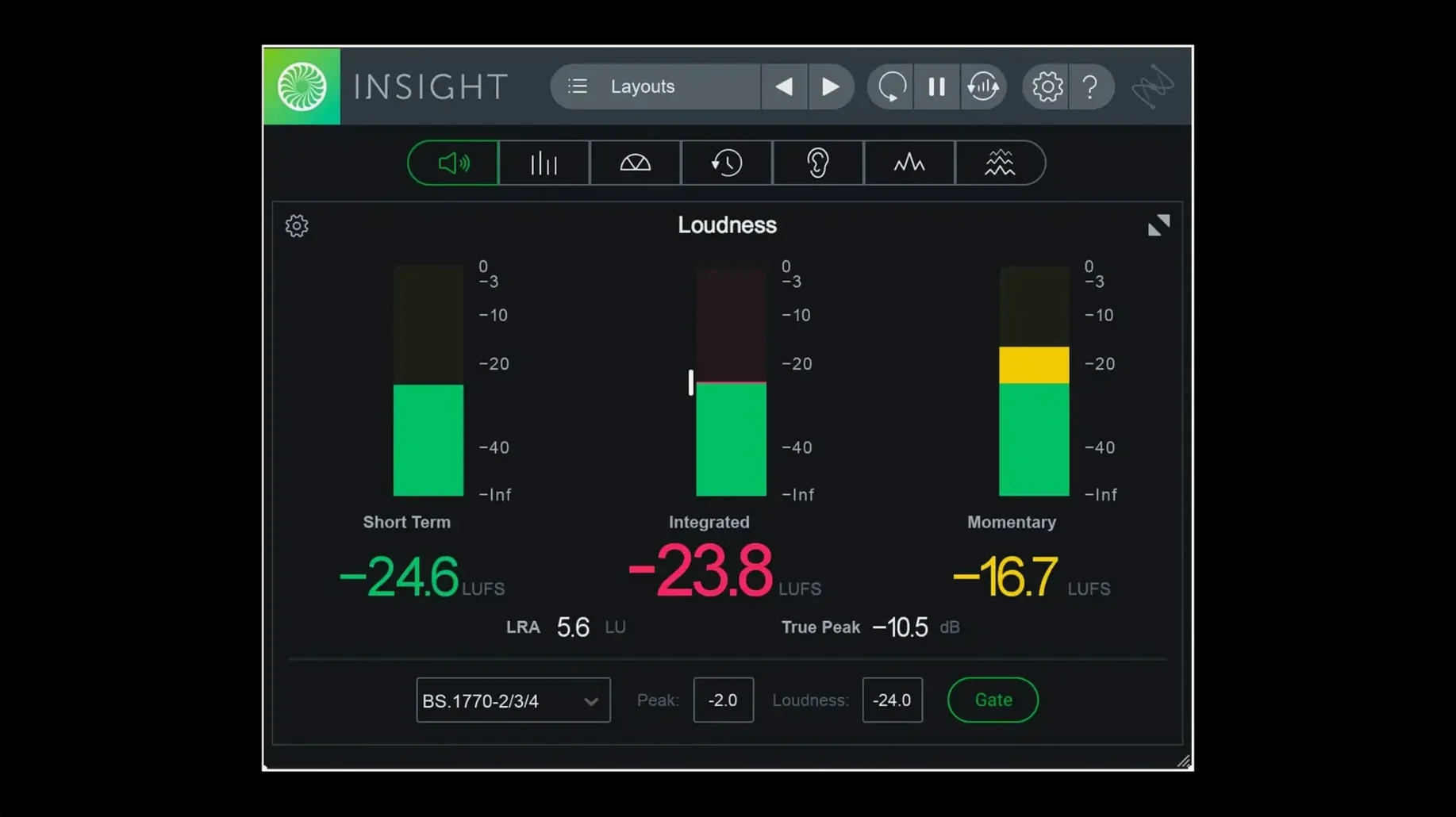
Insight runs on any Mac with macOS Big Sur or later, native on both Intel and Apple silicon machines. The 2.4.0 update brought arm64 AAX support for Pro Tools 2023.3 and above, alongside a cleaner install process for Apple silicon Macs. It loads as an insert on mono, stereo and surround channels up to Dolby Atmos 7.1.2.
Where it sits: tracks, buses and typical jobs
- Master bus: the Loudness History Graph and True Peak Meters verify an entire mix against current broadcast standards in real time. Colour signals flag overs before export.
- Dialogue and stem auxes: a configurable Loudness Meter lives on the dialogue bus, while the Stereo Vectorscope checks phase on a music stem return.
- Sound design tracks: the 2D and 3D Spectrogram reveal low-end rumble and harmonic clutter that a simple peak meter misses.
- Surround beds: the Surround Scope monitors channel balance across a 7.1.2 bed during a live print.
Reading the room: visual feedback that catches problems
Each module can be resized and placed where it makes sense in a session layout. The Spectrum Analyzer, Vectorscope and Loudness History Graph all update fluidly, turning potential mix problems into a visible signal rather than something you catch too late on headphones. Preset management was reworked in this version: factory and custom preset tabs sit side by side in the preset manager, which speeds up switching between a broadcast loudness layout and a dialogue editing view.
Three Mac users who glance at Insight all day: composer, mixer, podcast editor
Insight is not the kind of tool everyone needs open all day. A composer sketching ideas against picture gains little from a loudness history graph. But for three kinds of Mac user, it becomes a screen they glance at as often as the timeline itself.
The post-production mixer working to spec. Broadcast deliverables demand integrated loudness targets, true-peak ceilings and dialogue-gated measurements. Insight's preset manager — now split into factory and custom tabs — lets this user switch between an EBU R128 layout for one client and an ATSC A/85 layout for another without rebuilding meters. The Loudness History Graph runs during a full print pass, and a red true-peak flag at minute eighteen is worth more than any waveform view.
The music mixing engineer who trusts their ears but not their room. A stereo mix can sound balanced on nearfields and collapse in mono. The Stereo Vectorscope and the correlation meter catch phase issues that a quick car-test would reveal too late. The Spectrum Analyzer, pulled wide across a second display, shows low-end build-up that an untreated corner hides. These are not creative tools — they are confirmation tools, and for someone mixing on headphones late at night, that confirmation matters.
The sound designer building complex layers. A single gunshot composite might stack four library layers, each with its own low-frequency tail. The 2D Spectrogram exposes overlapping rumble before it reaches the master bus. The Surround Scope, when working in a 5.1 or 7.1.2 session, confirms that a rear-channel ambience is not accidentally bleeding into the centre speaker at -12 dB and pulling the image backwards.
Apple silicon support: Pro Tools startup CPU bump disappears
The shift to native Apple silicon support altered session startup for Pro Tools users. Previously, loading Insight under Rosetta on an M1 or M2 machine meant a small but noticeable CPU bump when opening a heavy metering layout. With the arm64 AAX build — compatible with Pro Tools 2023.3 and later — the plug-in initialises faster on Apple silicon, and the real-time spectrogram redraws without the micro-stutter some users saw on translated Intel code.
The preset tabs change a small daily habit. Before 2.4.0, factory and user presets shared a single flat list; scrolling past fifteen factory layouts to reach a custom dialogue-metering setup was friction. Now the two tabs sit clearly apart. A post editor can keep three custom layouts — one for dialogue editing, one for stem printing, one for full-mix QC — and reach each with a single click.
Multi-user installation support matters in facilities: a studio with five Macs and rotating freelancers no longer needs manual workarounds to install once for all accounts on a machine. Relay, which previously bundled with Insight, is no longer included in the installer; users who need it fetch it separately, which keeps the Insight package lighter.
Early missteps: what beginners tend to get wrong
The most common mistake is running every meter at once on a single insert. A full layout — Loudness Meter, True Peak, Vectorscope, Surround Scope, Spectrogram, Spectrum Analyzer — redraws constantly and eats GPU cycles for no reason. Experienced users open only the two or three modules relevant to the task and close the rest. A dialogue editor needs loudness and true peak; a sound designer needs the spectrogram; nobody needs all six simultaneously.
Another misstep: reading the Loudness History Graph without understanding the time window. A momentary loudness drop at a scene transition is normal and not a mix fault. Beginners sometimes chase a flat graph and over-compress a dynamic section that was working perfectly. The graph is a diagnostic, not a target shape.
A third habit worth catching early: ignoring the routing. Insight reads whatever signal it receives. Placed post-fader on a dialogue bus, it reflects fader rides; placed pre-fader, it shows the raw clip level. A mixer who inserts it post-fader and wonders why the loudness reading is 2 LU lower than expected has simply forgotten that the fader is pulled down.
Snags and solutions: small frustrations and their fixes
The Surround Scope shows blank channels. This happens when Insight is inserted on a stereo track while set to a surround layout. The fix is to instantiate it on a surround bus or change the plug-in's channel configuration to match the track width. Insight does not auto-detect track format; it trusts the user to set it correctly.
True Peak readings disagree with another meter. Different true-peak algorithms can differ by a few tenths of a decibel, but a larger discrepancy usually means Insight is measuring post-limiter while the other meter is pre-limiter, or vice versa. Check the insert order on the master chain.
The Spectrogram lags on an Intel Mac with a large session. Reducing the FFT size in the Spectrogram settings lowers the processing load. The trade-off is less frequency detail, but for spotting broad low-end problems, a smaller FFT works fine. Users on Apple silicon rarely hit this, as the native arm64 code handles the real-time redraw more efficiently.
Presets do not recall the window size. Insight remembers the module layout but not the plug-in window dimensions; those are managed by the DAW. If a custom layout feels cramped after recall, resizing the plug-in window and resaving the session usually restores it.



Correspondence 0
Take a chair or join the table to send a letter.
No correspondence on this note yet. Letters are read before they appear.