 LeCoqRoti
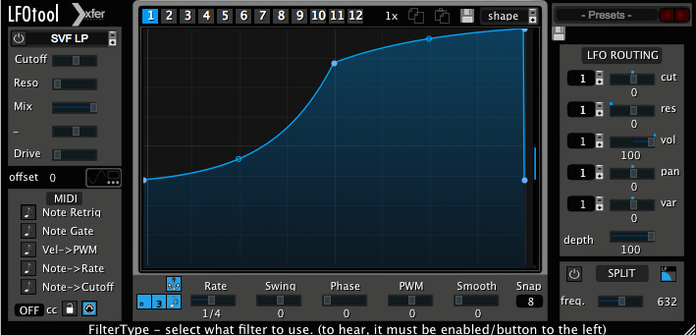
LFOTool is an audio effect that turns drawn curves into precise modulation movement or MIDI control data.
Shape modulation: draw the curve
Its point-and-tension editor lets you bend an LFO far beyond the usual sine and triangle shapes. Pull a node, adjust the tension, and the waveform follows — useful for filter wobbles, gated volume chops, or envelope-style rises that need a specific contour.
Tighten the groove: BPM sync with swing
Sync the rate to your host tempo and introduce swing to push or pull the rhythm of the modulation. Set the graph to run in hertz when you want free-running movement that ignores the grid entirely. Up to four graphs can run simultaneously, each locked to its own rate and shape.
Reach outside the channel: MIDI CC output
Instead of modulating an internal parameter, route the curve as a stream of MIDI CC messages. This lets you animate a hardware synth's filter cutoff or control a software instrument's expression from within LFOTool's editor — all with sample-accurate timing and low CPU overhead thanks to its C++ core.
Fit with the host: where LFOTool sits in a project
LFOTool behaves as a standard insert effect, which means it works most naturally on an instrument or audio channel where the modulation target lives. On a synth track, one instance can shape cutoff, resonance and pan from separate graphs; on a drum bus, a single curve can impose a pumping feel without touching the mixer's sidechain routing. The MIDI output opens a second placement option: run it on an empty MIDI track and let the generated CC stream travel to any instrument in the project.
Because it appears as VST, AudioUnit or AAX depending on the host, it slots into most macOS setups without extra routing software. In Logic Pro it loads as an AudioUnit; in Ableton Live or Bitwig the VST version keeps parameter automation available in the same lane as any other device. The plug-in reads host transport and tempo directly, so a project that changes time signature or BPM mid-arrangement will carry the LFO rates along without manual correction.
Small conveniences: details worth knowing
A few parts of the interface reward a closer look. The curve editor accepts tension adjustments per node, so a steep sidechain-style dip can be softened at its corner without reshaping the whole graph. Dragging near a node, rather than on it, changes curvature first — useful when the timing of a dip is already right and only the attack character needs work.
The preset system holds up to twelve graphs per patch, and switching between them can be done by MIDI note or host automation. That makes a single LFOTool instance behave like a bank of modulation patterns: one graph for verse filter movement, another for chorus panning, a third for a breakdown trill. Automating the graph selector from an arrangement lane keeps the changes sample-accurate and visually clear.
On the output side, MIDI CC messages follow the exact curve shape rather than a stepped approximation, so hardware with low-resolution CC handling still receives smooth values. The same graph can simultaneously process audio and send MIDI, which suits layered patches where an internal filter sweep should track an external synth's expression.
A working day: the mix engineer's view
Consider a mix engineer preparing a remix of a four-to-the-floor track. The original kick and bass are locked into the arrangement, but the producer wants the chorus to breathe more. Instead of rebuilding sidechain compression across every bus, the engineer drops LFOTool on the bass group, selects a preset close to a quarter-note dip, and pulls the curve's release node until the bass ducks just enough to let the kick transient through.
The same instance then sends a CC curve to the pad synth's filter cutoff, opening it slightly on the offbeat. In the breakdown, a second graph runs a slow hertz-based pan on the percussion bus while the first graph stays silent. Everything stays inside one plug-in window, and the whole modulation map moves with the project tempo when the final edit changes the chorus from 124 to 126 BPM.
Single graph on a saw: learning tension and curve
Start with a single graph and a single target before building multi-graph presets. A filter cutoff on a simple saw patch reveals how tension, rate and curve shape interact more clearly than a dense mix. Once the feel is right, duplicate the instance and repurpose the copy for volume or pan — the same curve often translates well across targets.
Store the first useful graph set as a preset early, even if it feels unfinished. LFOTool's preset handling makes it easy to return to a working curve as a starting point for later sessions. When using MIDI CC output for the first time, set the destination instrument to a neutral patch and confirm the CC numbers match before shaping the curve in detail.




Correspondence 0
Take a chair or join the table to send a letter.
No correspondence on this note yet. Letters are read before they appear.