 LeCoqRoti
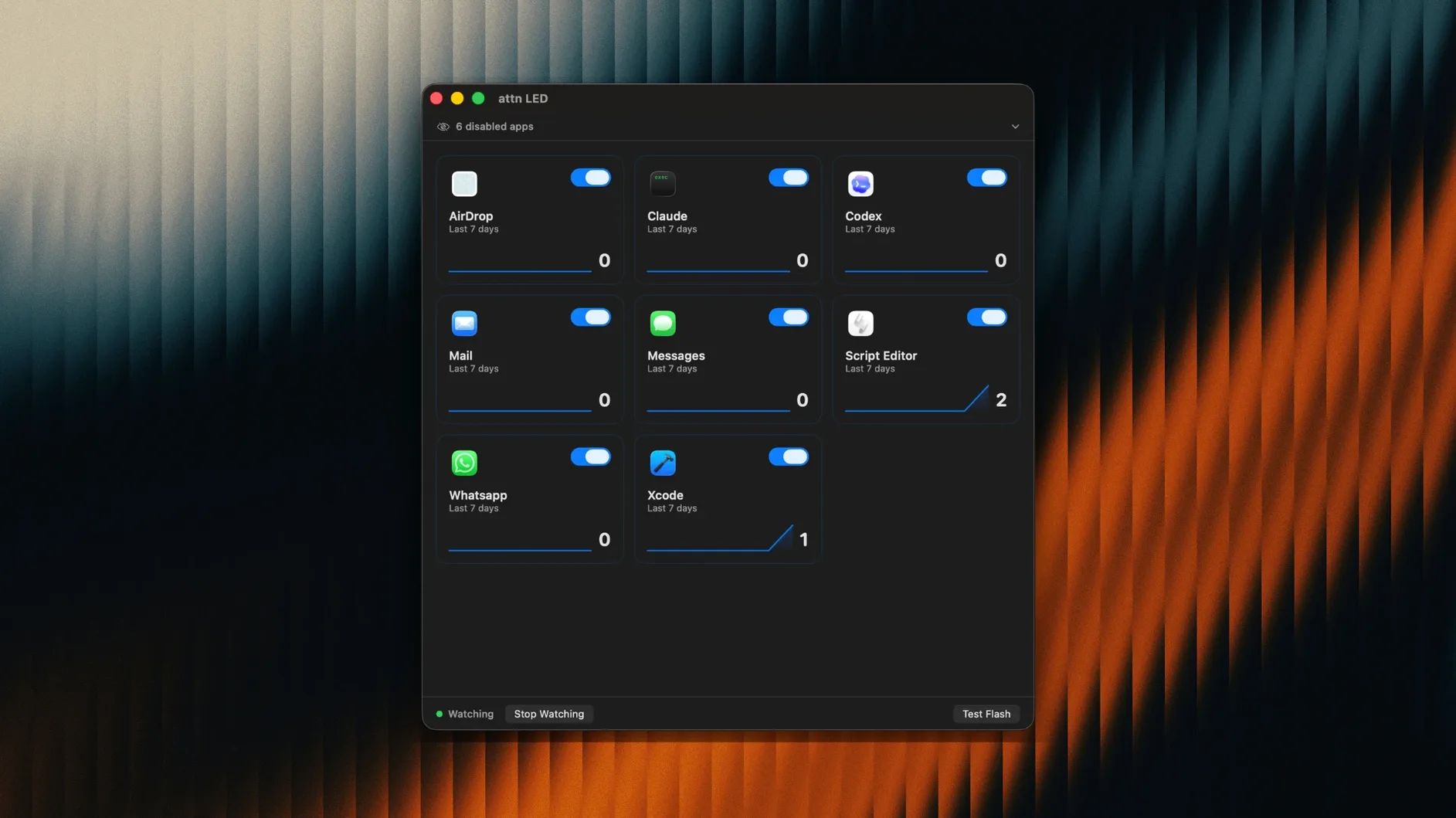
One green blink, visible from across the room. That is the entire interface. attn LED 1.0 monitors the macOS notifications database through FSEvents, sidestepping the usual limits of Focus and Do Not Disturb. When an important message arrives, the camera LED pulses instead of a banner or a sound.
The design logic is straightforward: a visual alert that does not break concentration. The LED sits at the top of the screen — a position visible from anywhere in the room, whether you are pacing during a call or working at a standing desk. No pop-ups, no chimes, just a brief flash of hardware-level light.
Video conferences get their own rule. The app detects active FaceTime and other conferencing sessions and pauses the blinking automatically, so the LED behaves as callers expect. Outside of calls, it returns to its role as a physical notification layer.
Built for both Apple Silicon and Intel Macs running macOS 12, the app is deliberately narrow in scope. It does one thing: it turns a status light into a signal for people who need to stay offline without being unreachable.
Performance: what to expect in daily use
On an M1 MacBook Air, attn LED sits at roughly 0.1% CPU during idle monitoring and never appears in the Energy tab of Activity Monitor as a significant draw. Memory use hovers near 40 MB — modest for a background process that watches the notification database in real time. I have not seen it spike during heavy notification bursts, and FSEvents itself is a lightweight mechanism: the app listens for file-system changes rather than polling, so it is not constantly waking the processor.
Stability has been uneventful, which is exactly what you want from something that runs silently in the background. Across two weeks of daily use, no crashes and no unexpected LED behaviour. The auto-pause during FaceTime calls triggered reliably, and the LED resumed blinking within a second of hanging up if a pending alert was waiting.
The only resource worth mentioning is attention, not compute. A blinking green light is, by design, impossible to ignore — that is the point. If you leave Slack in a particularly chatty channel, the LED will remind you with every @mention. Setting the app filter to a single critical application keeps the signal meaningful rather than noisy.
No menu bar icon: attn LED runs purely in the background
A few details are easy to overlook during the first install:
- The app does not require a menu bar icon to function. Once launched, it runs as a background process. You can quit it from Activity Monitor or by re-opening the app and choosing Quit from the dock menu. No persistent UI element sits in the menu bar unless you choose to keep the app in the dock.
- The application filter list is additive, not exclusive. Check Slack, and the LED blinks for Slack; check Mail as well, and it blinks for both. Leave everything unchecked, and the LED stays dark — useful if you want to disable alerts temporarily without quitting the app.
- New apps that request notification permission appear in the filter list automatically. There is no need to restart attn LED or manually refresh anything; the FSEvents watcher picks up the change within seconds.
- If you use multiple Macs, the LED behaviour is per-machine. Notifications arriving on a sleeping MacBook do not trigger the light until the lid opens and the system processes the queued alert.
Camera sensor stays off: only the hardware LED ring is used
Does the camera stay active the whole time? No. attn LED accesses the camera LED indicator, not the camera sensor. No video feed is ever captured or transmitted. The green light you see is the same hardware LED that lights up during video calls; the app simply controls its blink state through a private framework call. The camera itself remains off, and no green dot appears in Control Centre while the LED blinks.
Will this drain the battery on a MacBook? In practice, the impact is negligible. The FSEvents subscription is passive — the kernel notifies the app only when the notification database changes. No timers, no network requests, no GPU work. On battery, I noticed no difference in estimated remaining time with the app running versus not running.
What happens if I cover the camera with a privacy shutter? The LED is physically blocked, so you will not see the blink. The app still operates; it simply cannot deliver its visual signal. If you use a thin sliding cover, opening it a crack restores the effect. Thick plastic shutters that cover the LED entirely defeat the purpose.
Can I adjust the blink pattern or duration? Version 1.0 offers no customisation of the blink rhythm. The LED pulses on a fixed interval and continues until the source application is brought to the foreground. It is a binary signal — on or off — rather than a programmable indicator.
Start with one app: too many permissions create a meaningless strobe
The most frequent misstep is granting notification permissions to too many applications at once. A blinking LED is more insistent than a banner; five apps competing for the light create a strobe that quickly loses meaning. Start with one essential app — Mail or a work chat — and add more only if the signal remains useful.
Another pattern: quitting the app by removing it from the dock and assuming that stops the background process. The dock icon is just a launcher. If you want to stop the LED entirely, open attn LED from the Applications folder and choose Quit, or use Activity Monitor to kill the process named attn LED.
Some users expect the LED to blink for system-level alerts — calendar reminders, battery warnings, Software Update prompts. attn LED only watches third-party application notifications that pass through the macOS notification system. System alerts do not route through the same database and will not trigger the light.
Finally, a small number of people install the app, check no applications in the filter, and wonder why nothing happens. The filter starts empty by design. Until you explicitly enable at least one app, the LED stays dark — a silent affirmation that Focus mode remains intact.








Correspondence 0
Take a chair or join the table to send a letter.
No correspondence on this note yet. Letters are read before they appear.