 LeCoqRoti
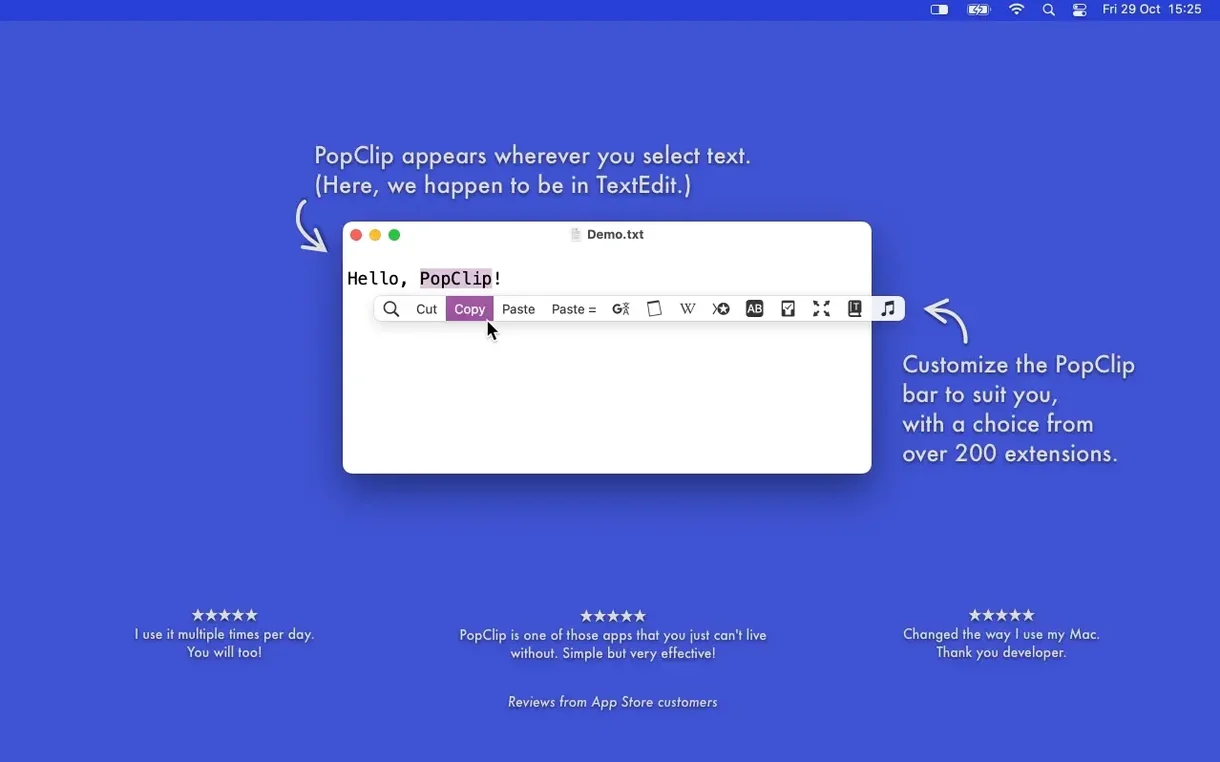
Selecting text on a Mac is a gesture you perform dozens of times a day, yet the follow-up action — copy, search, paste — still requires a trip to the keyboard or the menu bar. That small gap between selection and action is where PopClip lives.
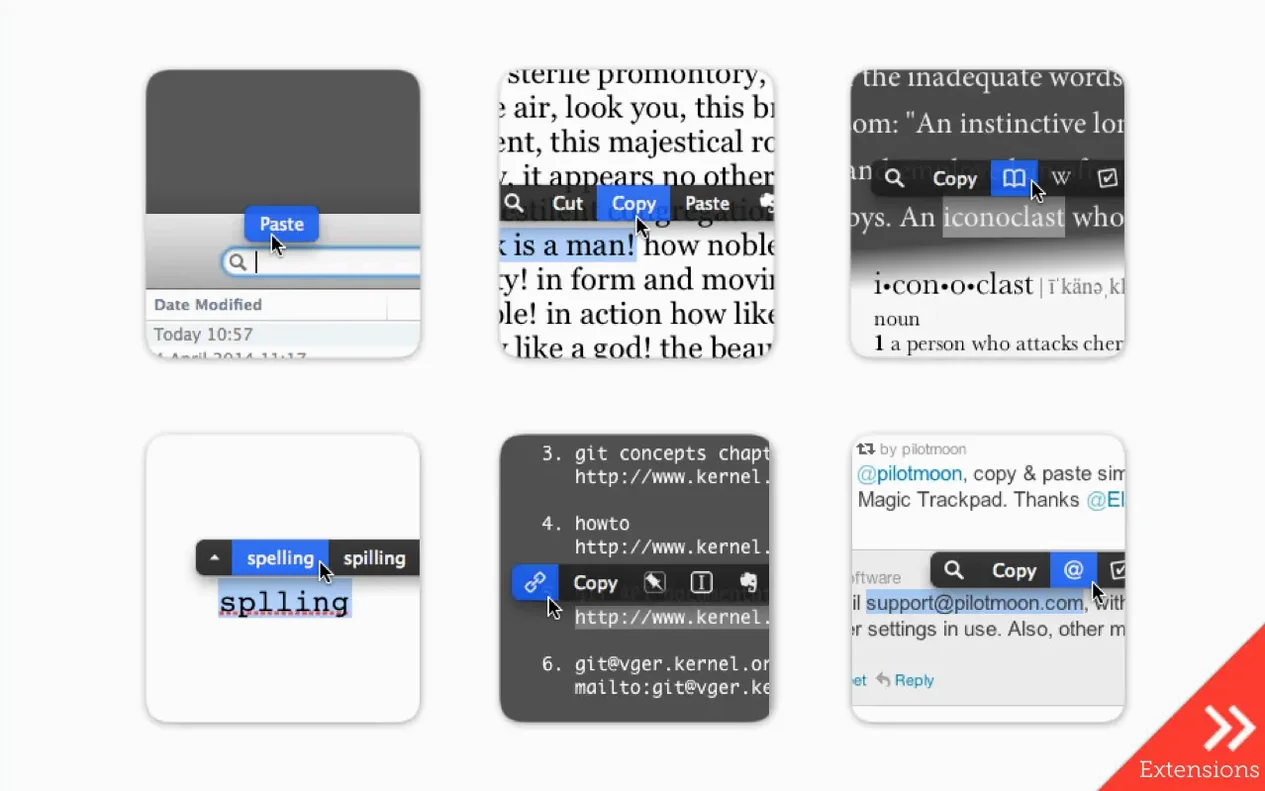
Once installed, selecting any text with your mouse summons a compact row of context-sensitive buttons right above the highlight. The app reads what you selected: a URL gets an "Open Link" action, a single word might offer a dictionary lookup or translation, and any text block can be sent to a web search or Evernote with a single click. The default set covers copy, paste with style matching, word count and case conversion, with extensions adding further reach.
Instant case changes while drafting: editing without disruption
- Writers and editors working with raw text who want instant case conversion or word counts without breaking flow
- Researchers who regularly search the web for highlighted terms
- Anyone who sends text snippets to Evernote and wants to skip the copy-switch-paste routine
Mouse-only popover: the interface stays invisible to trackpad users
- The interface appears only with mouse selection; trackpad-only users will never see it
- Extensions and layout sync between your Macs via iCloud, so a setup on one machine follows you to another
- It requires macOS 13.5 Ventura or later and runs on both Apple Silicon and Intel 64-bit Macs
Small conveniences: gestures and rules you acquire slowly
Most people install PopClip, appreciate the copy button, and stop exploring. A handful of design choices reward closer attention. If the popover appears in the wrong place — too close to the edge of a window — a quick flick of the scroll wheel nudges it left or right along the text. No settings panel required. Holding the Shift key while clicking an action keeps the popover alive for a second action, which turns a two-step workflow into a single fluid motion: copy, then search, without re-selecting. On a Mac with a Touch Bar, the same action set mirrors itself there, which is easy to miss if you rarely glance down.
Blocked apps are another quiet feature. Some applications — terminal emulators, certain code editors, remote desktop windows — respond poorly to a floating overlay inserting text. PopClip lets you add any app to a blocklist from the menu bar icon, and the popover simply stops appearing there. No digging through preferences. The exclusion list lives in the same menu that shows your extension catalogue, so you can toggle it while the offending app is still in front of you.
A working session: editing a newsletter draft
Imagine a Tuesday morning in Bear. A draft newsletter sits in the main window, half-edited, full of placeholder links and inconsistent capitalisation. You select a title in sentence case, click the "Capitalize Words" extension, and the whole line shifts. A few paragraphs down, a URL sits unlinked: highlight it, and PopClip offers "Open Link" — you tap it to check the destination in Safari, then return. The same selection, with Shift held, also gets "Copy URL" so you can embed the link properly.
Later, a paragraph you wrote the night before feels wordy. You select it, hit the word-count extension (a single icon tap), and the count appears in a small overlay: 47 words, comfortably under the 60-word limit for that section. A misspelled name gets a red underline from macOS and a suggested correction in the popover — tap to fix. Finally, you highlight a pull-quote and use the "Send to Evernote" extension to drop it into a research notebook for next week. No menu diving, no keyboard shortcuts memorised. The popover appears, does its job, and vanishes.
Pick five extensions first: avoiding a cluttered popover
On day one, open the extension catalogue from the menu bar icon and install the ones that match your daily tools. The catalogue contains over a hundred free extensions, but starting with five or six keeps the popover compact and fast to scan. Consider adding "Translate," "Send to Evernote," "Word Count," "Paste and Match Style," and "Case Conversion." You can always add more later; an overstuffed bar on day one feels like clutter, not help.
Spend ten minutes in an app where you write often — a text editor, a notes app, a browser text field — and simply select text to see what appears. Notice which actions surface automatically. Some, like "Open Link," only show when the selection looks like a URL. That conditional logic is the heart of the tool, and learning what triggers what removes the guesswork when you are in a hurry.
Finally, decide whether you want the popover to appear after a short delay or instantly. The default is a brief pause, long enough that quick double-clicks do not summon it by accident, but the timing slider in preferences can drop it to zero if you prefer immediacy. Try the default for a few hours before changing it: the pause exists because most people find the instant appearance startling at first.
Almost every Mac app: exceptions rely on nonstandard selection
Does it work with every Mac app? Almost. PopClip relies on standard macOS text-selection protocols, so it integrates naturally with native apps like Pages, Notes, Mail, and Safari, as well as many third-party tools. Some apps — particularly those using custom text-rendering engines, remote desktop clients, or virtual machines — may not expose selected text in a way PopClip can read. For those rare cases, the blocklist covers the gap without affecting other applications.
Will it interfere with my existing copy-paste shortcuts? Not at all. PopClip uses the standard system clipboard and does not remap or intercept keyboard shortcuts. The popover sits alongside your existing workflow — use it when you want a one-click action, ignore it when you prefer ⌘C. The two approaches coexist without conflict.
What about privacy when searching or translating text? Actions like web search and translation send selected text to external services (your default search engine or the translation provider you choose). PopClip itself does not collect or store text; the data flows directly from the selection to the service, exactly as if you had pasted it into a browser or translation app manually. Extensions that work offline, such as word count and case conversion, never leave your machine.
Can I try older versions if I read about PopClip 2025.9 or earlier releases? The current version, 2026.8.1, is a maintenance release following PopClip 2026.7. Older builds are not distributed through the usual channels, but the app's design philosophy has stayed consistent across versions: the core experience — select text, see actions, click — has been stable for years. Looking at a PopClip download from the current release is the best way to understand what the tool offers today.






Correspondence 0
Take a chair or join the table to send a letter.
No correspondence on this note yet. Letters are read before they appear.