 LeCoqRoti
Which Macs does Farrago 2.2.0 run on?
Farrago 2.2.0 requires macOS 14 Sonoma or later, and it runs natively on both Apple Silicon and Intel 64-bit Macs. If your machine is on the current operating system, the app will fit without a hiccup.
What does a soundboard app actually do?
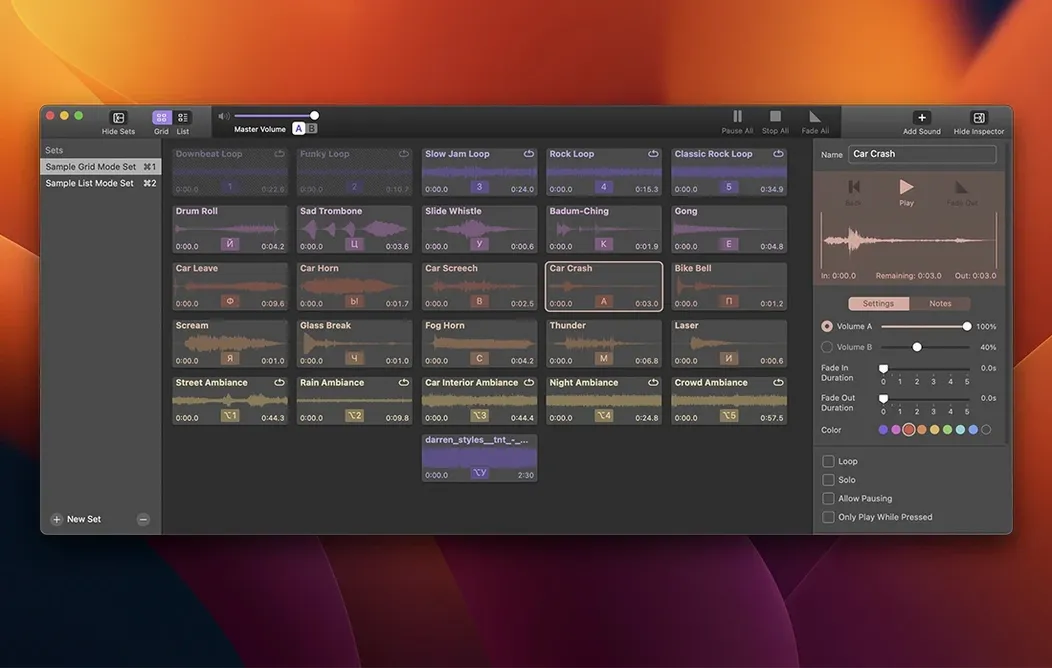
It is a rapid-access trigger pad for audio: sound effects, music stings, spoken clips. You tap a tile and the sound fires instantly, with independent volume for each tile and the ability to set custom in and out points per clip.
How does Farrago keep a large library manageable?
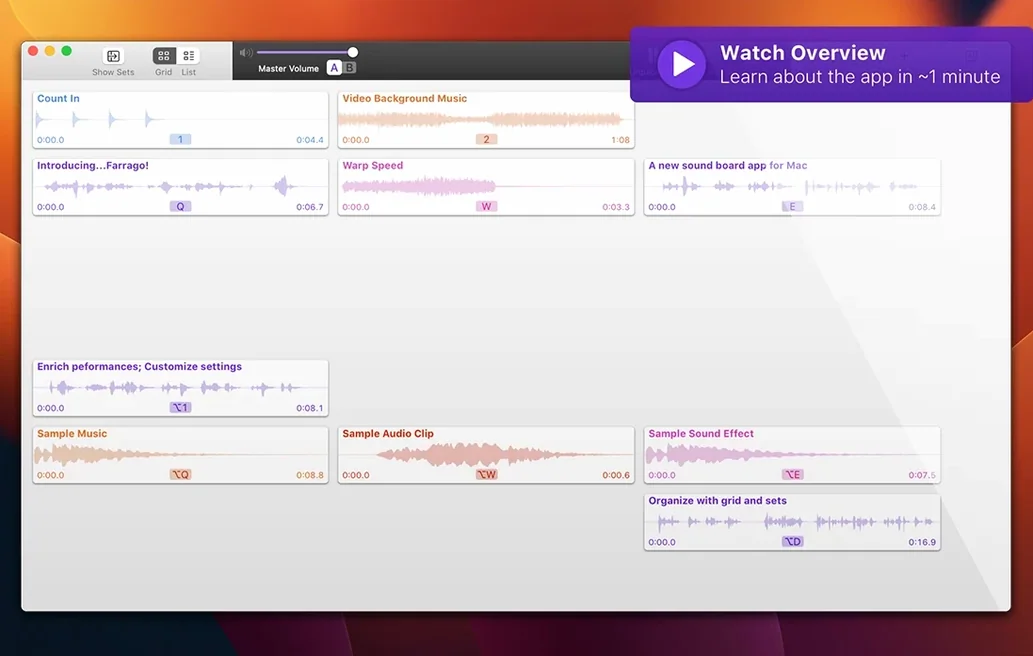
Sounds are grouped into named sets you can switch between, and the tile grid gives you a direct spatial map of your audio. A list view is also available for sequential playback when you need a linear run of cues.
Podcast editors: tile grid as tactile extension of logic
Podcast editors and live-stream producers get the most immediate return. The tile grid becomes a tactile extension of logic: intro sting here, sponsor read there, correction drop over there. Because each tile holds its own fade and trim settings, you can feather a music bed in and out without touching a timeline. Pairing Farrago with Loopback sends clean, pre-faded audio direct to a recording track in Audio Hijack, and the whole chain runs without a single physical cable.
Theatre technicians and radio operators value the MIDI integration above everything else. A basic MIDI controller—pads, foot switches, a beat controller—maps to tiles in seconds, which turns Farrago into a hardware cue player that fits in a laptop bag. During a show, a technician can fire door slams and thunder rolls by muscle memory alone, never looking at the screen. The dark theme matters here: in a dim booth, a white interface would be a distraction. Farrago stays quiet and low-lit.
Tabletop game masters and voice-chat users use the app in a looser, more improvisational way. A set might hold tavern ambience, sword clashes, creature calls and a few comic drops. Hotkeys on the F-keys keep hands free for dice and notes, and the per-tile output control means a dragon roar can hit six decibels louder than the background rain loop without adjusting system volume.
How Farrago compares with similar Mac apps
Next to QLab, the comparison is about scope. QLab is a full theatre and live-event control system with video, lighting and multi-track audio timelines. Farrago does not attempt any of that; it is a single-layer sound trigger. For a complex musical with scene-cued projection changes, QLab is the right tool. For a panel show that needs twelve stingers and a laugh track, Farrago is lighter, faster to set up, and far simpler to reconfigure mid-session.
Next to Soundboard Studio, the difference is in interface philosophy. Soundboard Studio uses a mixing-console metaphor with layered channels and effects inserts. Farrago uses a flat grid of independent tiles. That flatness is an advantage when you need to scan twenty sounds at a glance and hit the right one in half a second. Soundboard Studio offers more signal processing per channel; Farrago offers more direct, unmediated reach.
Next to Bose SoundTouch or consumer soundboard apps, Farrago stands apart through its integration with Rogue Amoeba’s audio routing ecosystem. The ability to send tile audio to a specific virtual device in Loopback, while system sounds stay on the main output, is not a feature you find in lightweight alternatives. For anyone searching farrago for mac free download or farrago macos, the attraction is partly that professional routing capability—it is the same audio engine that powers the developer’s broadcast tools.
A working session: building a live radio cue sheet
You open farrago mac to an empty set. The grid sits grey and silent. You drag in a folder of station IDs, sponsor beds and transition effects from the Finder. The app copies each file into its own library, so the originals can move or be deleted later without breaking the set.
You name the tiles: “News intro,” “Weather bed,” “Listener mail sting,” “Outro long.” Each gets a colour: red for urgent cues, blue for music beds, grey for utility drops. You trim the weather bed to a tight eight seconds with the in-and-out sliders, and you add a two-second fade-out so it never cuts off mid-bar. The news intro stays sharp and full-length.
You assign hotkeys: F1 through F8 for the primary row. Then you plug in a small MIDI pad and map the physical pads to the same tiles, doubling the control surface for moments when your hands need to stay off the keyboard. A quick test confirms that the MIDI pads fire with no perceptible latency.
During the broadcast, you work from the tile grid as a visual score. A guest makes an unexpected joke; you tap the rimshot tile with a finger on the trackpad, then kill its tail with a second tap. The sponsor read ends; F5 triggers the outro bed, which fades itself over four seconds while you deliver the sign-off. Nothing clips, nothing overruns, and the audience hears only what you intended.


Correspondence 0
Take a chair or join the table to send a letter.
No correspondence on this note yet. Letters are read before they appear.