 LeCoqRoti
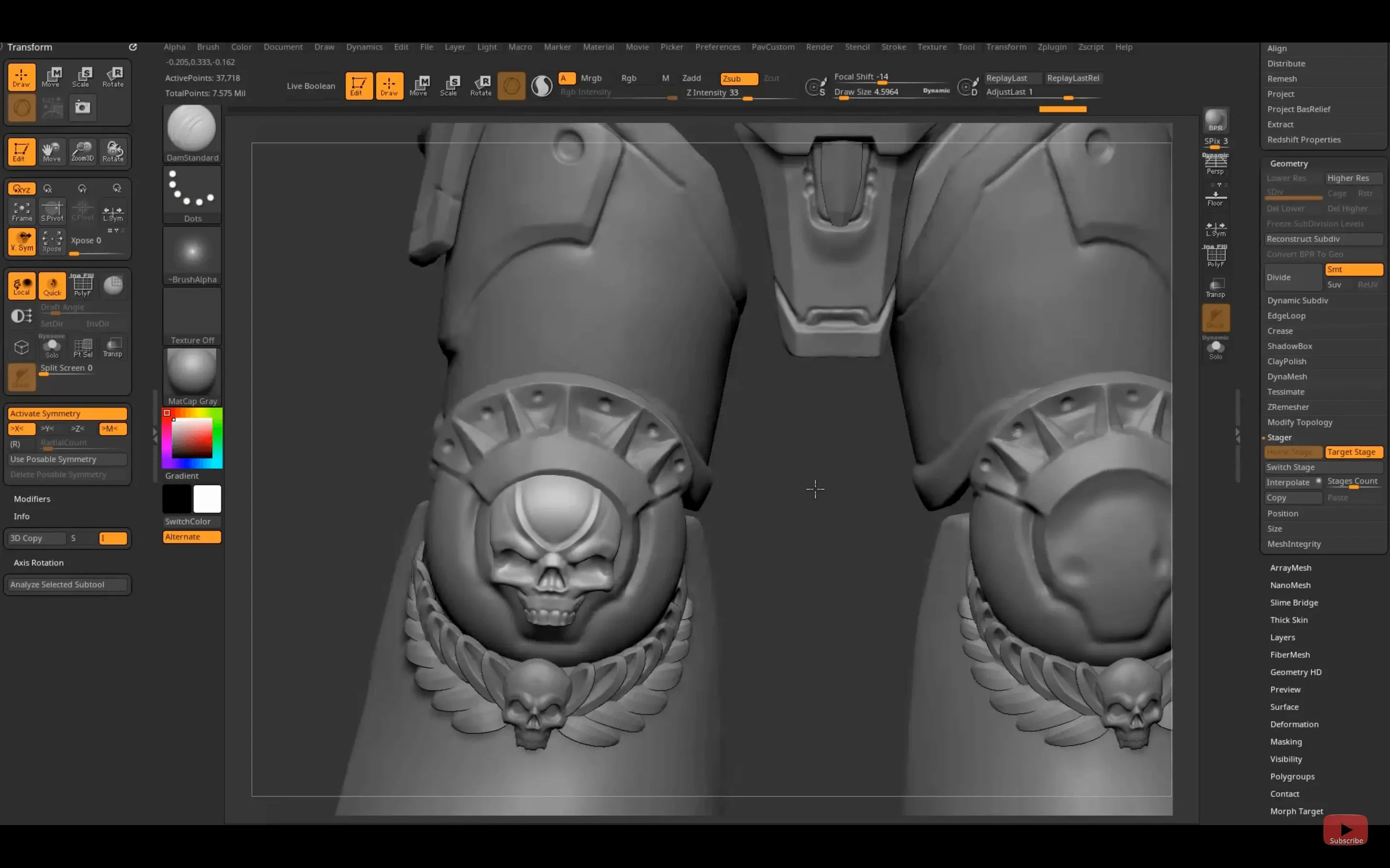
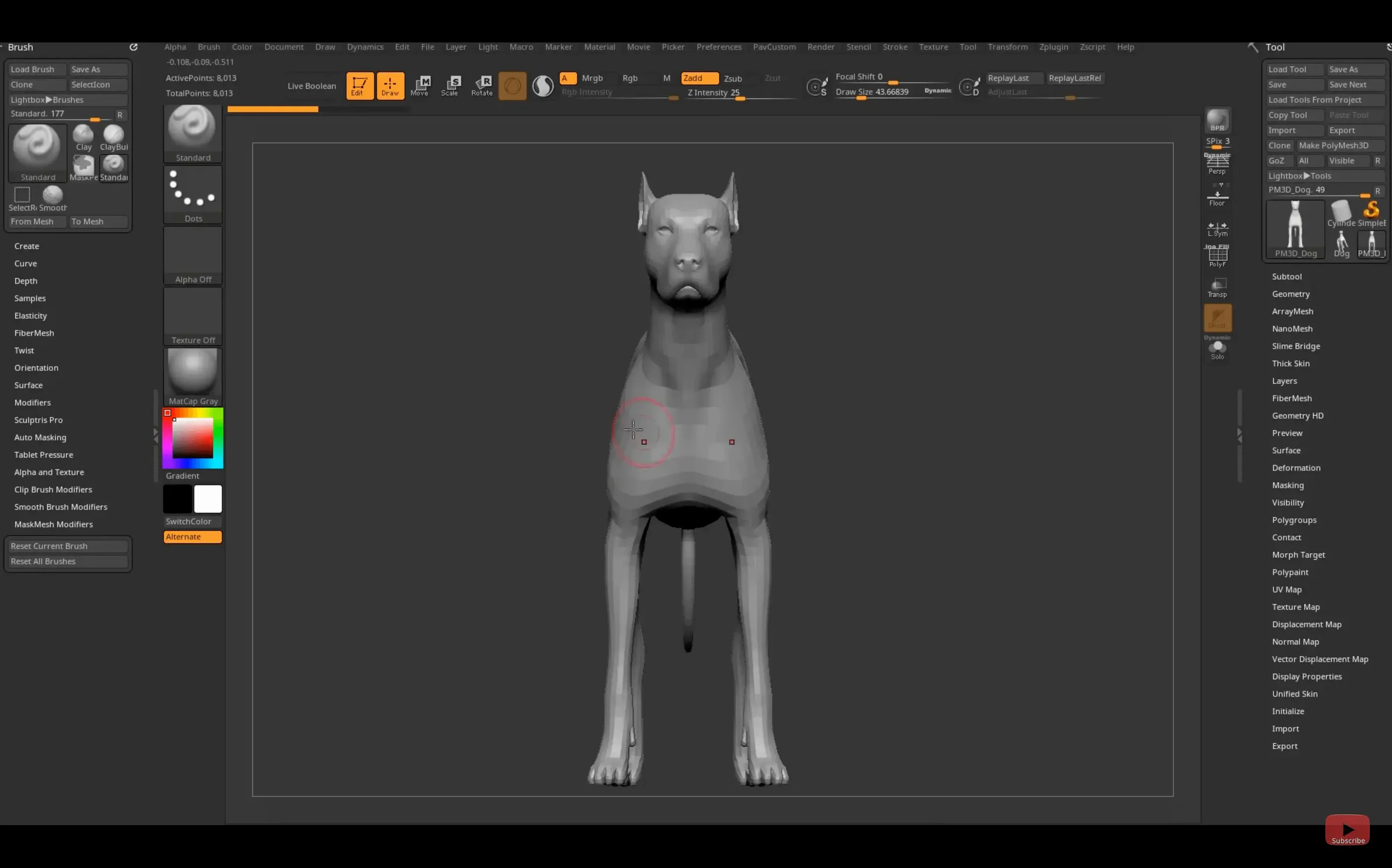
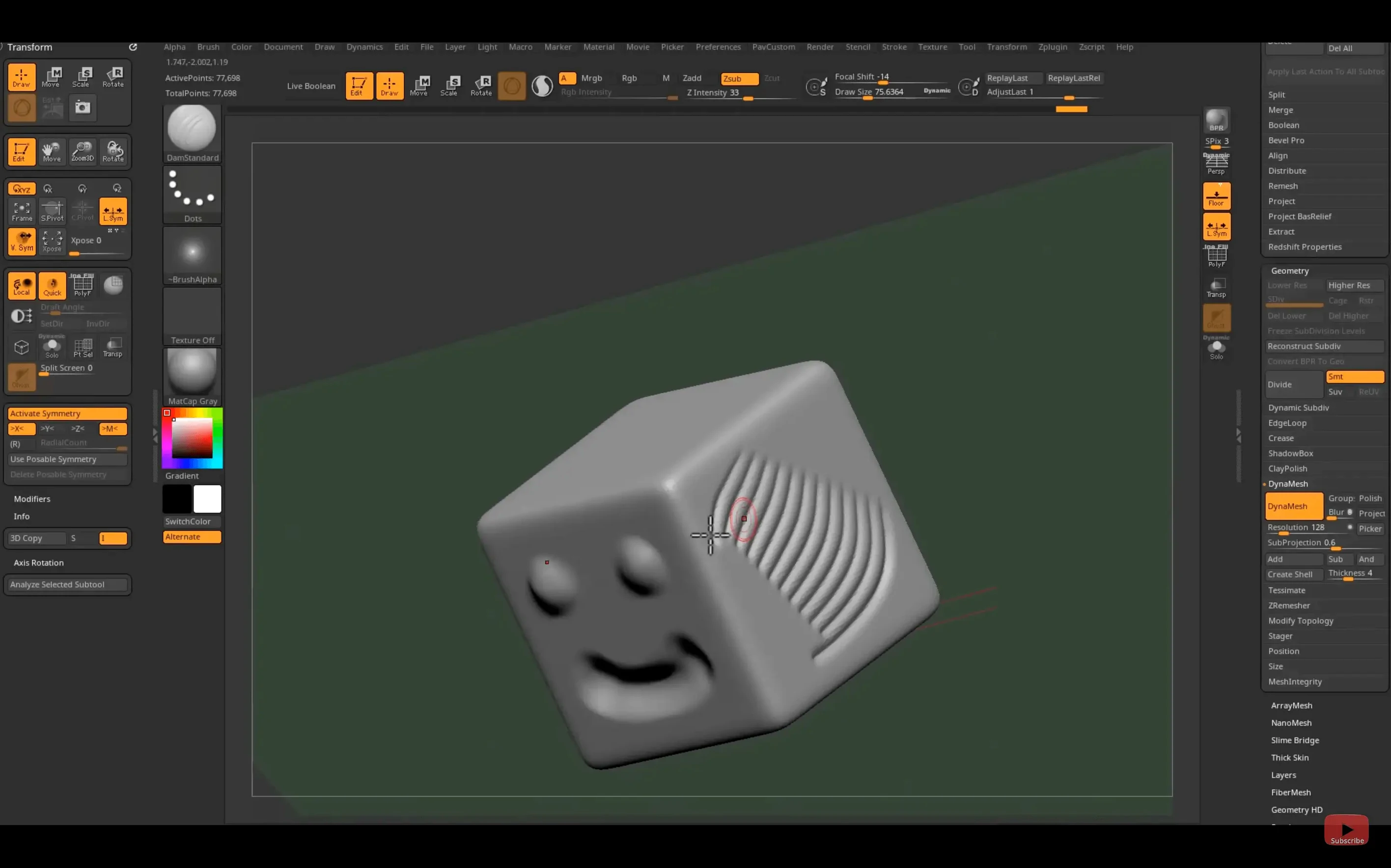
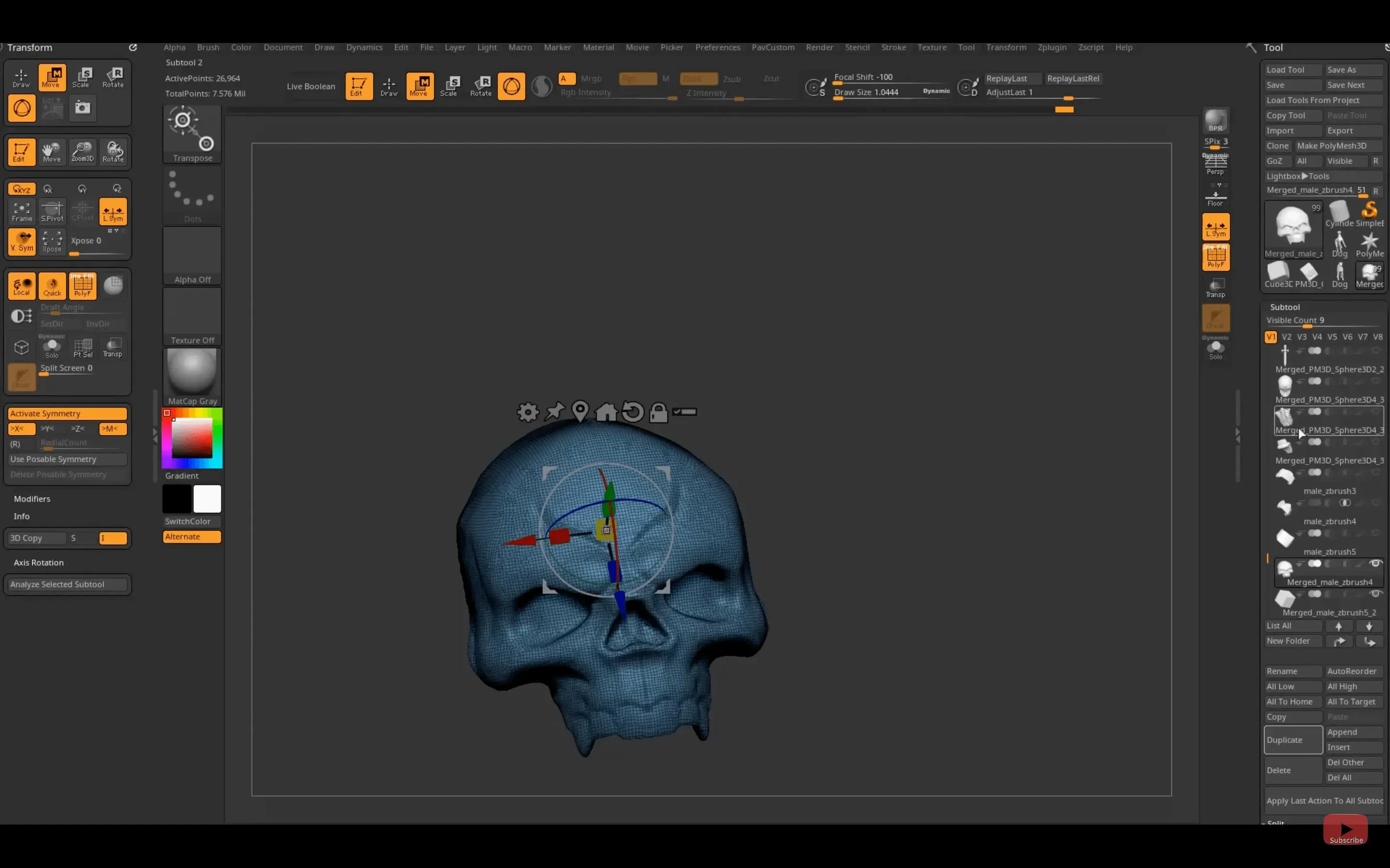
Anchor brushes let you pull a form out of a surface with a single stroke, and that gesture—direct, physical, unmediated—says a great deal about how ZBrush approaches modelling. Every point on the canvas is a pixol: it remembers not just colour and XY position but also Z depth, orientation, and material. The result is a working environment that simulates hand sculpting on a screen, without the topology constraints that slow down a traditional polygon modeller.
- High-polygon sculpting: The engine handles tens of millions of polygons in real time, so you can carve skin pores, fabric weave, or weathered stone directly on the model rather than faking it with texture maps.
- Depth-aware painting: Strokes carry material, colour, and depth information simultaneously; paint a scar and it sits below the surrounding surface, catching light from the 3D renderer as you rotate the view.
- Real-time rendering: Shadows, ambient occlusion, and subsurface scattering update live on the canvas, giving an honest preview of how the sculpt will read under final lighting.
- Interoperability with Maxon tools: GoZ bridges the scene to Maya, 3ds Max, and Cinema 4D with a button press, preserving subdivision levels and polypaint data for texturing or rigging downstream.
- Cross-platform consistency: The same file opens on Mac, Windows, and iPadOS, and the 2026.2 release lets iPad users save and share custom hotkey configurations—useful when moving between a desktop studio and a mobile sketch session.
In short: ZBrush treats a model as a block of raw material rather than a wireframe cage, and the toolset is built around that idea from the ground up.
GoZ bridges to Maya 2026 without extra steps
A sculpt rarely stays inside ZBrush. The macOS version connects outward through GoZ, which has been updated in 2026.2.1 for Maya 2026 and 3ds Max 2026, so the bridge keeps pace with Autodesk's release cycle. In practice that means a character blocked out in ZBrush can move to Maya for rigging, to Cinema 4D for scene assembly via the Maxon ecosystem, or to Substance Painter in a single click using the new Substance Bridge. Each transfer preserves polypaint, UVs, and subdivision history; the round-trip is clean enough that texture artists often receive a high-poly sculpt, bake maps in Painter, and send it back without ever opening a separate mesh-export dialogue.
On the system side, ZBrush reads Apple's Metal API for viewport rendering, so the orbit, pan, and zoom gestures on a Magic Trackpad feel native. It also respects macOS colour management: a sculpt previewed on a P3 display translates predictably when the file moves to a Windows machine for rendering, because the pixol data stores absolute material values rather than screen-referred colour. For users who work across an iPad and a Mac, the 2026.2 update added custom hotkey saving and sharing on iPad—a small change that removes the friction of reconfiguring shortcuts every time you switch devices. And because the desktop version runs natively on both Apple Silicon and Intel hardware, a Mac Studio in the studio and an older Intel iMac at home handle the same file with the same toolset, no emulation layer needed.
Pushing faces into expression without touching vertices
Character artists in game and film production tend to live inside ZBrush for the bulk of a project, because the ability to push and pull a face into a specific expression without touching a vertex feels closer to clay than to CAD. Concept artists use it differently: they treat a base mesh as a sketchpad, blocking out three or four creature variations in an afternoon and presenting turntable renders directly to a director. The real-time renderer makes that possible—ambient occlusion and subsurface scattering update as they sculpt, so the turntable reads as a finished image rather than a grey-shaded preview.
Scientific illustrators and toy sculptors form a quieter but equally dependent audience. A palaeontological reconstruction or a collectible figurine demands surface detail at a resolution that would choke a standard modeller: skin folds, scale overlap, the texture of cast metal. ZBrush handles those polygon counts routinely, and the depth-aware painting system lets an illustrator paint a healed wound or a layer of rust with actual relief, catching light from the same renderer that will produce the final print or mould output. These users rarely need the full animation pipeline; they need a sculpt that holds up at extreme close-up, and the software delivers that without asking them to manage edge loops or subdivision cages.
A workflow: from base mesh to presentation render
Consider a jewellery designer building a signet ring with an engraved crest. The workflow starts outside ZBrush, with a simple ring base blocked in a CAD tool and exported as an OBJ. The mesh is imported into ZBrush, where the designer immediately subdivides it to around two million polygons—high enough that the engraving strokes will read as fine lines, not faceted approximations.
The engraving itself uses the Slash brush set to a small radius, carving the crest into the ring face with a series of controlled strokes. Because each stroke stores depth and orientation, the designer can rotate the ring under a strong key light and see the cuts catching shadow in real time, adjusting the depth of a particular groove by brushing over it again with a lower intensity. Once the crest reads correctly, polypaint adds a patina: dark brown in the recesses, a muted gold on the raised surfaces, applied with a spray stroke across the whole ring band. The depth-aware painting automatically keeps the dark colour inside the engraved lines, because the brush respects surface angle as well as screen position.
For presentation, the designer opens the LightCap editor and builds a three-point lighting setup directly on the canvas, saves a turntable animation as a QuickTime, and exports an STL of the final sculpt for 3D printing. The entire process—import, sculpt, paint, render, export—happens without leaving the application. No UV unwrapping, no texture baking, no shader authoring. The ring exists as a single ZTool file that can be reopened next week for a variant design, with all subdivision levels and polypaint intact.
Substance Bridge removes the mesh-export roundtrip
The 2026 line brought changes that affect how the software sits alongside other tools rather than how it sculpts internally. The Substance Bridge, introduced in 2026.2.1, cuts out the intermediate step of exporting a mesh, setting up a Painter project, and manually reassigning material zones. A sculptor working on a multi-material asset can now send the high-poly version to Painter with one command, bake maps there, paint across UV tiles, and return the textured model without losing the sculpt layers. For artists who previously juggled half a dozen file exports between sculpt and texture stages, this collapses the round-trip into something that feels almost like a live link.
The GoZ updates for Maya and 3ds Max 2026 follow the same logic: keeping the bridge current means a studio updating its Autodesk pipeline mid-project does not suddenly lose the ability to send geometry back and forth. On the iPad side, the addition of portable hotkey configurations addresses a specific pain point. A freelancer who sculpts on an iPad during a commute and then docks at a Mac in the evening can carry not just the file but the muscle memory—the same key layout moves with them, stored as a shareable preference file. None of these changes alter the core sculpting engine, but together they reduce the time spent on file management, which for a production artist can amount to an extra half-hour of actual sculpting per day.







Correspondence 0
Take a chair or join the table to send a letter.
No correspondence on this note yet. Letters are read before they appear.