 LeCoqRoti
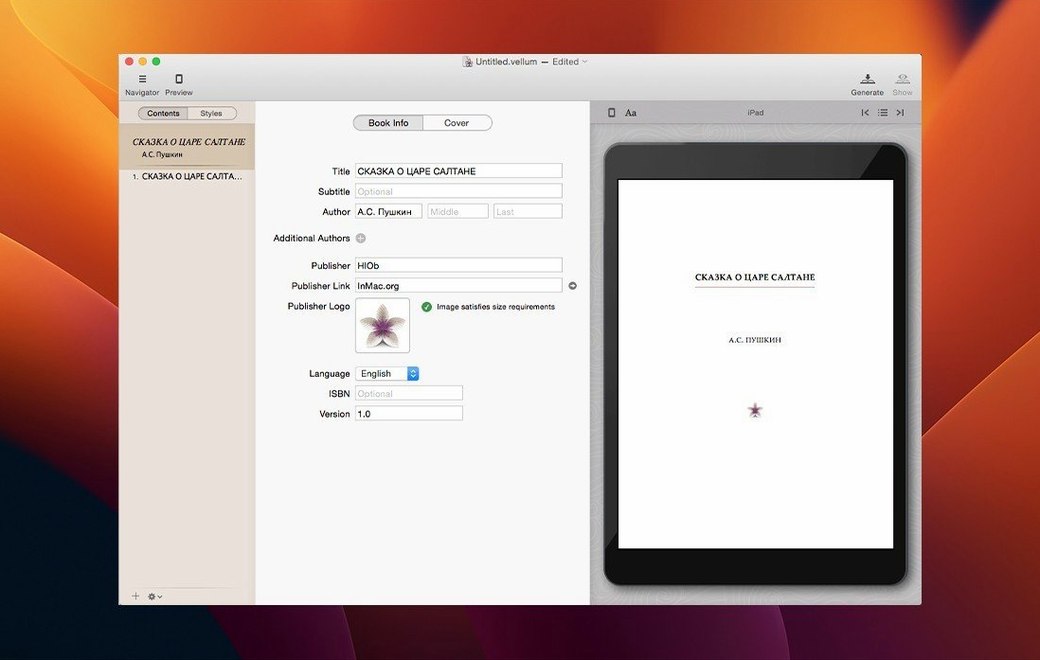
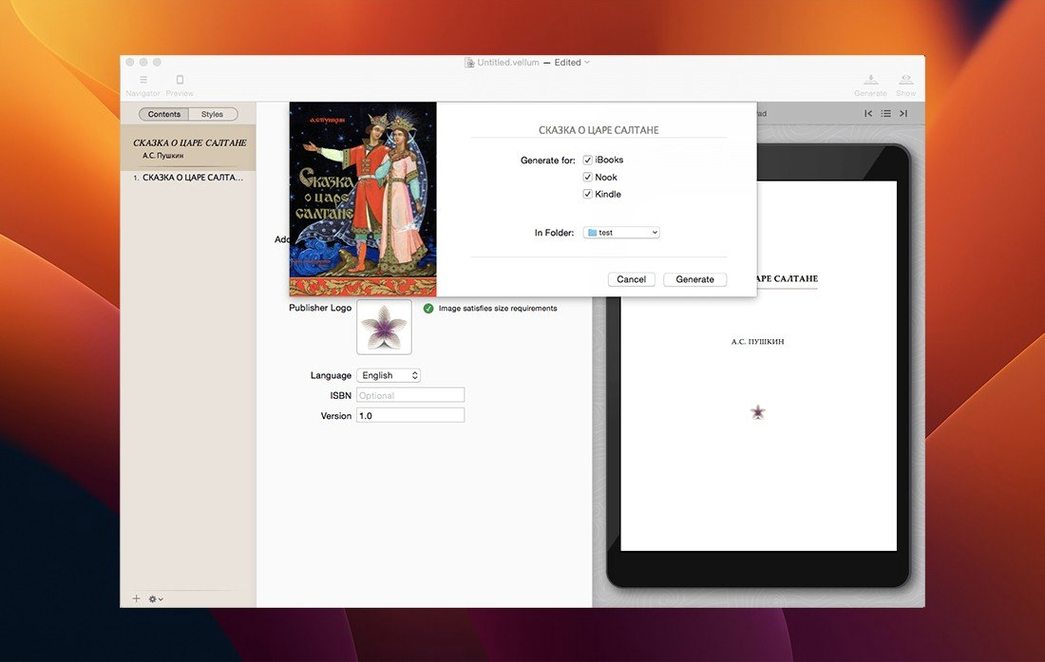
A writer finishes a manuscript in the evening and wants to see it as a proper book by morning. She drags the Word file into Vellum, and the app builds a title page, a styled table of contents, and a flowing preview she can page through while the kettle boils.
What the current version continues to do well:
Native Mac presence — A lean, English-language workspace built for Apple silicon and Intel Macs running macOS 11 or later. The interface stays quiet, letting the text hold the stage.
Instant preview — While editing, the book appears live, exactly as a reader would encounter it on a device. No exporting or guessing.
Multi-format output — Generates ebooks for Kindle, Kobo, and Apple Books. When a last-minute typo surfaces, simply regenerate the file without rebuilding the layout.
Two paths to a book — Start from a manuscript, or open a blank document and compose directly inside Vellum. Both routes lead to the same polished result: a volume that feels considered, not merely converted.
First days: what to check before you format a single chapter
Most new users open Vellum, import a manuscript, and begin tweaking ornaments straight away. A quieter approach pays off later. Spend the first session on three things the interface does not nag you about, but which shape every subsequent decision.
Set the trim size before choosing a style. Vellum recalculates margins, headers, footers and page numbers the moment you change the dimensions. Pick a style early by all means, but lock the trim first: a 6×9 inch page breathes differently from a 5×8, and a style that looked airy can turn cramped after the switch.
Walk through every element in the preview sidebar. The device previews are not decorative. Tap through iPhone, iPad, Kindle and print views while you still have only two sample chapters. You will catch things that are invisible in the editing pane — a heading that orphans on a phone screen, a block quote that loses its indent on an e-reader, or a copyright page that sits too high in print. Fixing these early avoids a cascade of corrections later.
Let Vellum handle widows, but verify. The spread-balancing and widow control are on by default, and they work well for body text. Poetry, dialogue-heavy passages, and short epigraphs sometimes need manual line breaks. Spot-check those sections before you trust the automation across a full manuscript.
Who benefits most
A self-publishing author with a finished manuscript and a release date gains the most obvious advantage: one afternoon to go from Word document to upload-ready files for three storefronts. The time saved on formatting alone often covers the learning curve.
Small publishers and book designers who produce multiple titles a month will notice the boxed-set feature and the consistency engine. When every book in a series must share trim size, typographic scale, and front-matter layout, Vellum remembers the decisions and applies them to new volumes without drift. One designer described it as “a style guide that actually enforces itself.”
Writers who think best in a finished page — those who need to see their words set in a real font, on a real spread, before they can judge the prose — often draft inside Vellum directly. The blank-book path suits this temperament. The live preview becomes a mirror, not just an output check.
People who format books occasionally and dread the process will find the guided structure calming. The app does not expose kerning tables or CSS overrides; it offers a set of curated styles and a preview that updates as you type. The gap between “I have a manuscript” and “I have a book” shrinks to an evening.
A working session, from import to finished files
It is a Tuesday in late autumn. The manuscript — 78,000 words of historical fiction — sits in a .docx file named The Gesso Floor. The writer has blocked off the morning.
She drags the file onto Vellum’s welcome window. The app reads the document in seconds, detects chapter breaks from the heading styles she used in Word, and builds a table of contents. The title page appears with placeholder text: she types the book’s name and her own, and the preview reflects it immediately.
She selects a trim size — 5.5 × 8.5 inches — then scrolls through the style gallery. Each style previews on her actual chapters, not on lorem ipsum, so she can judge how her opening paragraph looks set in Garamond versus a contemporary slab-serif. She settles on a style called Lark, which pairs generous leading with small caps for chapter titles.
The copyright page needs attention. She opens the front-matter editor and adds a copyright line, an ISBN, and a brief note about the cover illustration. Vellum places it on its own page, right where a reader expects it.
Now she pages through the iPad preview. A chapter title sits too close to the top margin. She adjusts the heading spacing in the style controls, and the change propagates to every chapter heading in the book — past, present, and the one she has not yet written.
She finds two widows in chapter four. One fixes itself when she adjusts the tracking slightly; the other needs a soft return before the final sentence. She makes the edit in the text pane, not in some separate layout view, and the preview updates.
By lunchtime she has generated three files: a .mobi for Kindle, an .epub for Kobo and Apple Books, and a print-ready PDF. A colleague messages about a typo in chapter seven. She corrects “solider” to “soldier”, regenerates the ebook files, and sends the replacements — three minutes, no layout casualties.
How it sits alongside similar tools
Scrivener is the comparison most writers arrive with. Scrivener excels at the long, messy middle of composition: research folders, corkboards, manuscript splitting and reordering. Vellum picks up where that work ends. A writer can draft and restructure in Scrivener for eighteen months, export a .docx, and hand the polished text to Vellum for the final dressing. The two apps are not rivals; they are neighbours on the dock, each doing its own half of the job.
Atticus, a relative newcomer that runs in a browser as well as on Mac, aims for the same one-stop formatting experience. It offers more style customisation and a built-in word processor. The trade-off is interface weight: Atticus feels like a web application with many panels, while Vellum feels like a native Mac app with a single window and a preview that never refreshes. For writers who want deep control over every style parameter, Atticus gives more knobs. For those who want a decision made well and quickly, Vellum’s curated approach wins.
InDesign is the professional benchmark, capable of anything a print designer can imagine. It also expects the user to understand master pages, paragraph styles, and preflight checks. A book designer producing a heavily illustrated art monograph needs InDesign. An author producing a novel or a memoir does not. Vellum occupies the space InDesign leaves open: beautiful typography with almost no typographic labour.
In short: Vellum is the tool you reach for when the words are finished and the book needs to exist as an object readers can hold or scroll through — without a detour through layout manuals or CSS. It earns its place on the Mac of anyone who makes books, not as a matter of ideology, but simply because it removes friction from a stage that used to be full of it.







Correspondence 0
Take a chair or join the table to send a letter.
No correspondence on this note yet. Letters are read before they appear.