 LeCoqRoti
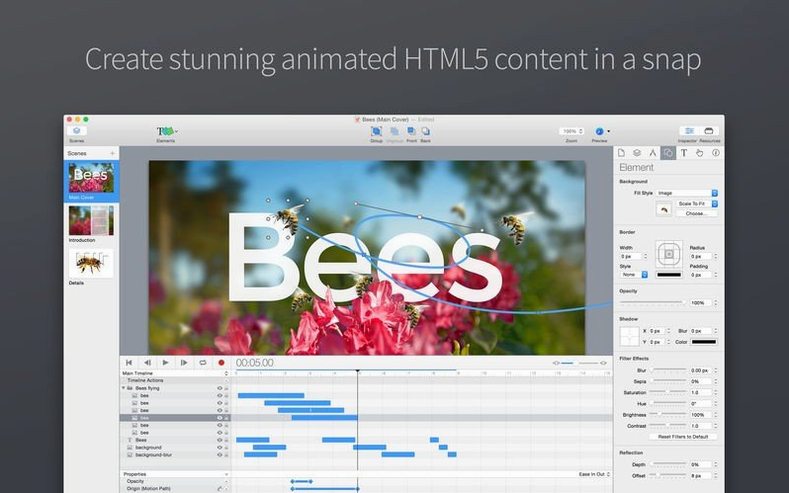
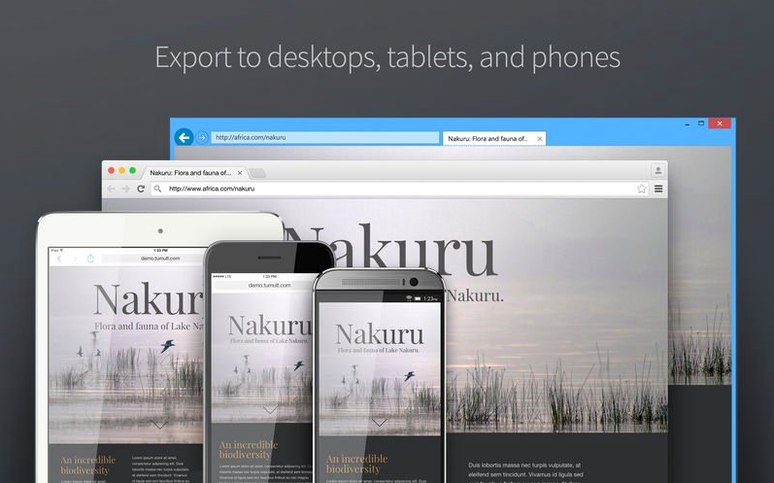
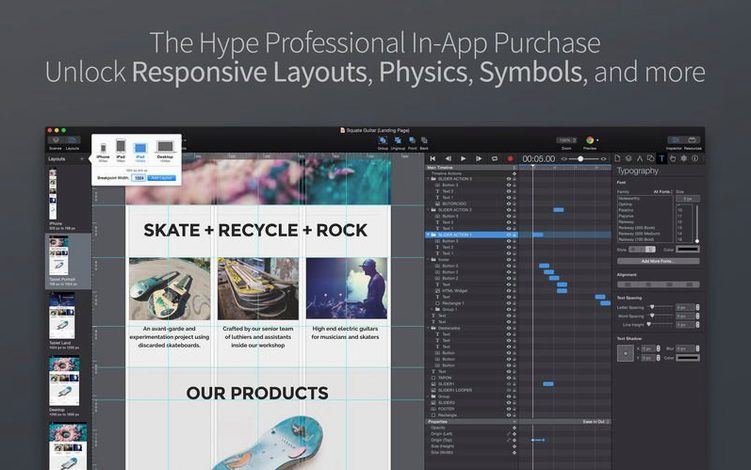
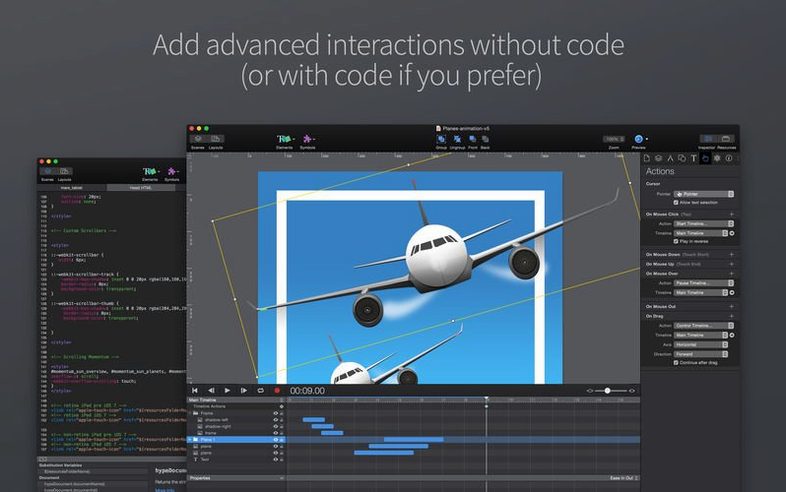
Many designers understand motion and interactivity intuitively but find the underlying code a barrier. Hype 4 Pro removes that obstacle by providing a visual, keyframe-based environment where you build HTML5 animations and interactive scenes directly, without touching a line of source code. The Professional edition extends the core toolkit with responsive layout controls, reusable symbols, and physics-based motion, all operating inside a familiar WYSIWYG editor. It is a tool for visual communicators who want their web output to feel alive, not static.
- Keyframe animation: Animate position, opacity, scale and colour along a timeline with editable timing functions.
- Interactive scenes: Add buttons, mouse-over effects and touch actions to create product tours or simple infographics.
- Symbols: Build once and reuse character rigs or interface elements across a project; persistent symbols keep their internal timeline state.
- Responsive layouts: Define flexible layouts that adapt an animation’s size and position for different browser widths.
- Physics engine: Apply gravity, friction and collisions for organic, secondary motion without manual keyframes.
- Sprite sheet import: Bring in sprite sheets and image sequences to use as compact animation sources.
Building a hover banner: from static strip to animated sign-up prompt
Imagine a promotional strip for a newsletter sign-up — static on page load, then unfolding with soft motion when the visitor’s cursor crosses it. Start with a blank scene at a common banner width, say 728 px. Draw a rounded rectangle for the background, give it a quiet fill, and place a headline, a short paragraph of body copy, and a button shape on separate layers. Group these as a symbol: the group will later hold its own internal animation while the main timeline stays clean.
Enter the symbol’s timeline. At 0.0 seconds, set the headline slightly off to the left with zero opacity; at 0.4 seconds, keyframe it back to its resting position at full opacity. Offset the body copy by 0.15 seconds and the button by 0.3 seconds for a gentle stagger. Use the editable timing functions to give each element a slight overshoot — ease-out with a custom curve works well here. Back in the main scene, add a single mouse-over action on the symbol that triggers its timeline, and a mouse-out action that reverses it. Export the scene. The entire banner is now a self-contained HTML5 snippet ready to drop into a CMS, no dependency on external libraries.
Small conveniences: overlooked gestures and shortcuts
A handful of details in Hype 4 Pro reward the observant. Most are not hidden, but they sit quietly in menus or modifier keys:
- Inspector nudging with arithmetic: In any numeric field — width, rotation, opacity — you can type +10 or *1.5 and Hype 4 Pro will compute the result. It saves constant mental arithmetic when scaling groups or offsetting keyframe values.
- Preview browsers from the menu: The preview menu now lists Zen, Helium, and Dia alongside the usual suspects. One click launches the current scene in a lightweight, single-purpose browser, useful for isolating animation performance without extensions interfering.
- Symbol library drag-and-drop: Once a symbol is created, dragging it from the library into a new scene preserves its internal timeline. Persistent symbols retain their playback state across instances — handy for animated loops that should not reset on every interaction.
- Scene copy with action retention: Right-click a scene thumbnail and duplicate it; all timeline actions, scene actions, and JavaScript triggers come along intact. This turns a finished micro-interaction into a template in seconds.
Hype versus Animate: a lighter, visual-first path to HTML5 motion
Placed alongside Adobe Animate, Hype 4 Pro feels lighter and more immediately visual. Animate carries decades of vector-drawing heritage and outputs to a wider range of formats, but its interface can overwhelm a designer who only needs HTML5 motion. Hype 4 Pro collapses the gap between the canvas and the browser: what you see in the editor is genuinely what renders on the page, with no SWF legacy layer to navigate.
Tumult Whisk, a lightweight sibling from the same developer, shares the WYSIWYG philosophy but stops at simple animated graphics with limited interactivity. Hype 4 Pro is the choice when scenes need buttons, timelines within timelines, or physics-driven motion. It is less a scaled-up Whisk than a different category of tool — Whisk for loops and GIF-like visuals, Hype 4 Pro for interactive micro-sites and web-ready prototypes.
Next to a code-first approach with GSAP or pure CSS keyframes, Hype 4 Pro occupies a middle ground: no hand-written JavaScript is required, yet the exported output remains a clean HTML5 bundle you can inspect and style further. For designers who want a hype 4 pro for mac free download that respects the visual workflow they already know, the trade-off is control through a timeline rather than a text editor — and for many animation tasks, that is precisely the point.
The output is self-contained HTML5, ready for any modern browser. In short: a composition tool for motion on the web, made for designers, not developers.






Correspondence 0
Take a chair or join the table to send a letter.
No correspondence on this note yet. Letters are read before they appear.