 LeCoqRoti
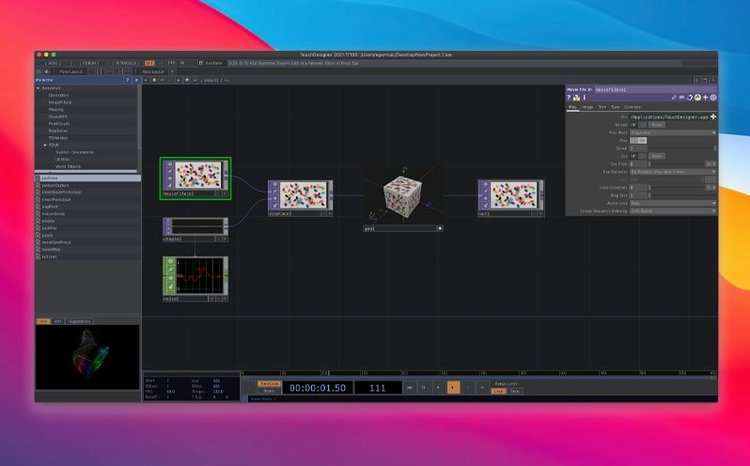
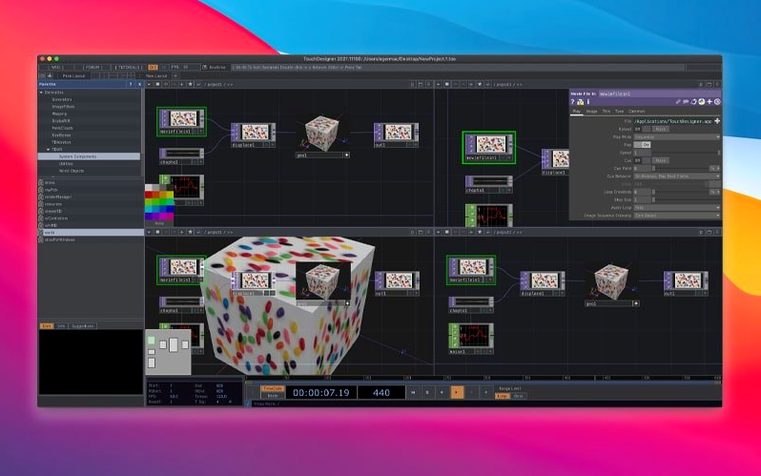
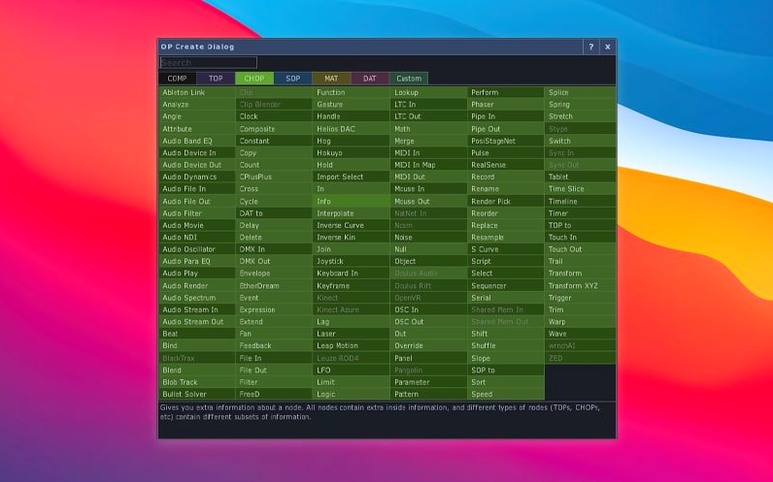
This release brings Point Operators to the surface and deepens native support for 3D textures across the operator family.
POPs (Point Operators) — a new operator family that creates and modifies 3D point data directly on the GPU, from generation and attribute manipulation to filtering and spatial queries.
3D textures and 2D arrays — most Texture Operators now handle volumetric data natively, opening a cleaner path for particle simulations, colour look-up volumes and layered compositing inside a single TOP network.
Orbbec SDK 1.10.16 — the depth-camera integration moves to a more recent SDK, improving compatibility with current Astra and Femto devices for installations that rely on real-time depth sensing.
Underneath the additions, the core remains what it has been for years: a visual programming environment where every cable, parameter and CHOP channel can talk to lighting equipment, audio systems, VR headsets and show-control networks. Projection mapping, interactive installations and live performance rigs are still its natural habitat, built by connecting operators rather than writing code from scratch.
Frequent questions: before you install
People often ask whether TouchDesigner replaces a traditional 3D package. It does not — it sits in a different place. You can model elsewhere and bring geometry in, or generate it procedurally inside the network, but the real strength is how everything reacts to time, input and data while it runs. The environment expects you to think in signal flow: a TOP feeds a CHOP, a CHOP drives a SOP, and the whole chain updates every frame without asking.
Another recurring question concerns performance on older Intel Macs. The software runs on machines meeting the macOS 10.14 baseline, but the GPU workload scales with resolution and node count. For real-time 3D scenes at 1080p or above, a discrete graphics chip makes a tangible difference. Integrated GPUs handle lighter compositing and MIDI-driven setups without complaint, though you will notice the fan during longer sessions.
The distinction between the free non-commercial licence and the paid editions also comes up often. The non-commercial version is functionally complete — every operator family, every protocol, every export resolution — and saves files with a watermark. For learning, prototyping and personal projects, nothing is locked away. Some users run a parallel setup on one machine: the same build for experiments and paid work, separated only by the licence key. A few search for TouchDesigner crack or TouchDesigner crack Mac to explore the application without the watermark, and the non-commercial tier already gives you the full toolkit.
Early snags and how to clear them
The most common bump on first launch is a blank viewport where a 3D scene should be. Nine times out of ten, the COMP node hierarchy has a Render or Render TOP missing, or the Render TOP is not pointing at the correct camera. TouchDesigner separates the scene description from the rendering step deliberately: you build geometry under a Geometry COMP, attach a Camera, then pipe everything through a Render TOP before it reaches the display. Open the network of an example file and trace the chain backwards from the final output to see the pattern.
Another frequent hiccup is MIDI or OSC input arriving but producing no visible change. The data usually flows into a CHOP that is not exported to the parameter it should control. Right-click the target parameter, choose “Export CHOP,” and check that the channel name matches. A quick way to verify is to drop a Trail CHOP after the incoming signal and watch the graph — if the numbers move there, the problem lies downstream in the binding, not in the connection itself.
Audio stuttering during playback often traces back to the buffer size in the Audio Device Out CHOP. The default is set conservatively for low latency with live input; bumping it to 1024 or 2048 samples smooths most dropouts on Intel Macs, at the cost of a barely perceptible delay. If stuttering persists, disable other operator viewers that update in real time: each open viewer panel adds a draw pass.
A mapping workflow: from image to surface
Projection mapping begins with calibration, and the cleanest method in TouchDesigner uses the Kantan Mapper tool inside a Stoner COMP. Drag a Stoner COMP onto the network, drop your content — a Movie File In TOP, a real-time camera feed, or a generative network — into its input, and open the Kantan Mapper interface. The viewport splits to show your content on one side and the physical projector output on the other. You move mesh points by hand, matching the geometry of the real surface until the two align.
From there, the Stoner COMP outputs a warped image ready for a projector. Connect a second output path if you want a monitor preview alongside the mapped projection: duplicate the final Composite TOP and route one copy to the display window and another to a fullscreen output on the projector display index. Setting the output resolution to match the projector’s native panel avoids scaling artefacts.
For installations that need to survive a restart, save the mapping data inside the Stoner COMP. The points persist as a binary table embedded in the .toe file, so the alignment holds between sessions. If the projector moves, open Kantan Mapper again, nudge the corners, and the rest of the network stays untouched. That separation between content and calibration means you can swap the source TOP from a video file to a live Shadertoy-style GLSL TOP without re-aligning anything.
Details you might overlook
The middle-mouse button on any operator reveals its info popup — a compact reference listing every input, output, parameter and flag. It is faster than opening the Help window and keeps your network visible while you check a setting. On a trackpad, a three-finger tap does the same.
Dragging a wire from an operator output while holding the Shift key opens a searchable palette of compatible downstream nodes. Type “blur,” pick the TOP, and the connection is made automatically. The same palette appears when you double-click an empty area of the network, but the Shift-drag method spares you the step of wiring by hand afterwards.
Operator snippets in the /local folder of your project directory act as reusable components that do not require a full .tox export. Drag any selection of operators to the file browser while holding Command, drop them onto a folder, and they appear as a named snippet. Dragging them back into a network re-creates the original layout with all internal settings intact. For a library of tested effects, filters and CHOP chains, snippets load faster than external .tox files and keep versioning simple.
On Intel Macs with limited GPU memory, the TouchDesigner Pro crack Mac phrase occasionally surfaces in forums alongside discussions of performance tweaks. A good practice with any installation is to reduce the “Cache Memory” setting in the Preferences under the TOPs tab: lowering it forces more frequent texture recycling and can prevent out-of-memory warnings during long sessions with many Movie File In TOPs running simultaneously.
Timeline mode: real-time for live sync
The Timeline should be set to “Real-Time” rather than “Frame-Based” the moment you open a new project. Real-Time mode stretches or compresses playback to match the wall clock, so an animation stays in sync with live audio and sensor input even if the frame rate dips. Frame-Based mode, the default, advances one frame per tick regardless of elapsed time, which drifts out of alignment with anything external.
In the Preferences dialog, under the UI tab, enable “Show Operator Info on Hover.” A small floating panel appears beside any operator you hover over for more than half a second, summarising its type, cook time and warning flags. The panel is draggable and dismissible with a click, and after an hour of building complex networks it becomes second nature to glance at it rather than opening the full parameter window.
The “Re-Init” button on Movie File In TOPs and Audio File In CHOPs deserves a mention not as a hidden trick but as a deliberate habit. After replacing a file on disk — a revised render from After Effects, a trimmed audio clip — clicking Re-Init reloads the file without breaking downstream connections. Skipping this step and dragging a new operator in each time clutters the network with orphaned nodes that share the same function. A clean network is a readable network, and readability pays off at three in the morning before a deadline.




Correspondence 0
Take a chair or join the table to send a letter.
No correspondence on this note yet. Letters are read before they appear.